Question
Using the standard electrode potentials given in Table $3.1,$ predict if the reaction between the following is feasible$: Br_2 (aq)$ and $Fe^{2+} (aq).$

Answer

$\ \ \ \text{Br}_{2\text{(aq)}}+2\text{e}^-\ \ \xrightarrow{\ \ \ \ \ \ \ \ \ \ \ \ \ } 2\text{Br}^{-}_\text{(aq)} \ \ \ \ \ \ \ \ \ \ \ \ \ \ \ \ \ \ \ \ \ \ \ \ \ \ \ \ \ \ \ \ \ \ \ \ \ \ ;\ \ \ \ \ \ \ \ \ \ \ \ \text{E}^\circ=+1.09\ \text{V}$
$\text{Fe}^{2+}_\text{(aq)}\ \ \ \ \ \ \ \ \ \ \ \ \ \ \ \ \ \ \xrightarrow{\ \ \ \ \ \ \ \ \ \ \ \ \ } \text{Fe}^{3+}_{\text{(aq)}}+\text{e}^-\big]\times2\ \ \ \ \ \ \ \ \ \ \ \ \ \ \ \ \ \ \ \ \ ;\ \ \ \ \ \ \ \ \ \ \ \text{E}^\circ=-0.77\ \text{V}$
$\overline{\text{Br}_\text{2(aq)}+2\text{Fe}^{2+}_\text{(aq)}\xrightarrow{\ \ \ \ \ \ \ \ \ \ \ \ \ }2\text{Br}^{-}_\text{(aq)}+2\text{Fe}^{3+}_\text{(aq)} \ \ \ \ \ \ \ \ \ \ \ \ \ \ \ \ \ \ \ \ \ \ ;\ \ \ \ \ \ \ \ \ \ \ \ \text{E}^\circ=+0.32\ \text{V}}$
Since $E^\circ$ for the overall reaction is positive, the reaction between $Br^2 (aq)$ and $Fe^{2+} (aq)s$ is feasible.

Need a full question paper?

Generate a complete, print-ready paper with questions like this in minutes — across 16+ boards, with answer keys.

Start Generating Free

Similar questions

What is the importance of amino acids to us?
Why are vitamin A and vitamin C essential to us? Give their important sources.
Explain how does the - OH group attached to a carbon of benzene ring activate it towards electrophilic substitution?
Explain the preparation of benzaldehyde by Etard and Gatterman$-$Koch reaction.
Explain (% V/V) Volume Percentage with examples.
Explain Catalytic property of transition element.
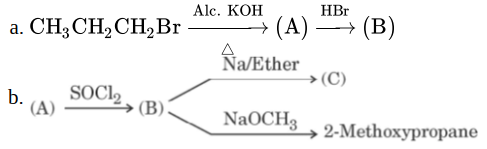
Complete the following reactions:
Image
Note: In the following questions a statement of assertion followed by a statement of reason is given. Choose the correct answer out of the following choices.
  1. Both assertion and reason are true and the reason is the correct explanation of assertion.
  2. Both assertion and reason are true and the reason is not the correct explanation of assertion.
  3. Assertion is true but the reason is false.
  4. Both assertion and reason are false.
  5. Assertion is false but reason is true.
Assertion: For measuring resistance of an ionic solution an AC source is used.
Reason: Concentration of ionic solution will change if DC source is used.
Give the major products that are formed by heating each of the following ethers with HI.
For the first order thermal decomposition reaction, the following data were obtained:
$\text{C}_{2}\text{H}_{5}\text{Cl}\text{(g)}\rightarrow \text{C}_{2}\text{H}_{4}\text{(g)} + \text{HCl}\text{(g)} $
Time/sec Total pressure/atm
$0$ $0.30$
$300$ $0.50$
Calculate the rate constant
(Given: $\log 2 = 0.301, \log 3=0.4771, \log 4 =0.6021)$