Question
Using the standard electrode potentials given in Table 3.1, predict if the reaction between the following is feasible:
Br2 (aq) and Fe2+ (aq).

Answer

$\ \ \ \text{Br}_{2\text{(aq)}}+2\text{e}^-\ \ \xrightarrow{\ \ \ \ \ \ \ \ \ \ \ \ \ } 2\text{Br}^{-}_\text{(aq)} \ \ \ \ \ \ \ \ \ \ \ \ \ \ \ \ \ \ \ \ \ \ \ \ \ \ \ \ \ \ \ \ \ \ \ \ \ \ ;\ \ \ \ \ \ \ \ \ \ \ \ \text{E}^\circ=+1.09\ \text{V}\\\text{Fe}^{2+}_\text{(aq)}\ \ \ \ \ \ \ \ \ \ \ \ \ \ \ \ \ \ \xrightarrow{\ \ \ \ \ \ \ \ \ \ \ \ \ } \text{Fe}^{3+}_{\text{(aq)}}+\text{e}^-\big]\times2\ \ \ \ \ \ \ \ \ \ \ \ \ \ \ \ \ \ \ \ \ ;\ \ \ \ \ \ \ \ \ \ \ \text{E}^\circ=-0.77\ \text{V}\\\overline{\text{Br}_\text{2(aq)}+2\text{Fe}^{2+}_\text{(aq)}\xrightarrow{\ \ \ \ \ \ \ \ \ \ \ \ \ }2\text{Br}^{-}_\text{(aq)}+2\text{Fe}^{3+}_\text{(aq)} \ \ \ \ \ \ \ \ \ \ \ \ \ \ \ \ \ \ \ \ \ \ ;\ \ \ \ \ \ \ \ \ \ \ \ \text{E}^\circ=+0.32\ \text{V}}$
Since E° for the overall reaction is positive, the reaction between Br2 (aq) and Fe2+ (aq)s is feasible.

Need a full question paper?

Generate a complete, print-ready paper with questions like this in minutes — across 16+ boards, with answer keys.
Start Generating Free

Similar questions

The depression in freezing point of water observed for the same amount of acetic acid, trichloroacetic acid and trifluoroacetic acid increases in the order given above. Explain briefly.
For a reaction
$2\text{H}_2\text{O}_2\xrightarrow[\text{alkaline medium}]{\text{I}^-}2\text{H}_2\text{O}+\text{O}_2$
the proposed mechanism is as given below:
  1. $\text{H}_2\text{O}_2+\text{I}^{-}\xrightarrow{\ \ \ \ \ \ \ }\text{H}_2\text{O}+\text{IO}^{-}(\text{slow})$
  2. $\text{H}_2\text{O}_2+\text{IO}^{-}\xrightarrow{\ \ \ \ \ \ \ }\text{H}_2\text{O}+\text{I}^{-}+\text{O}_2(\text{fast})$
  1. Write rate law for the reaction.
  2. Write the overall order of reaction.
  3. Out of steps (1) and (2), which one is rate determining step?
Explain the mechanism of the following reaction:
$\text{CH}_{3}-\text{CH}_{2}-\text{OH}\xrightarrow[443 K]{H^+}\text{CH}_{2}=\text{CH}_{2}+\text{H}_{2}\text{O}$
Explain the following with an example
(i) Reaction of phenol with zine dust.
(ii) Oxidation reaction of phenol.
Write chemical reaction of aniline with benzoyl chloride and write the name of the product obtained.
Give conversion: Ethene into butane.
Write the reactions of (i) aromatic and (ii) aliphatic primary amines with nitrous acid.
  1. Why are haloalkanes more reactive towards nucleophilic substitution reactions than haloarenes?
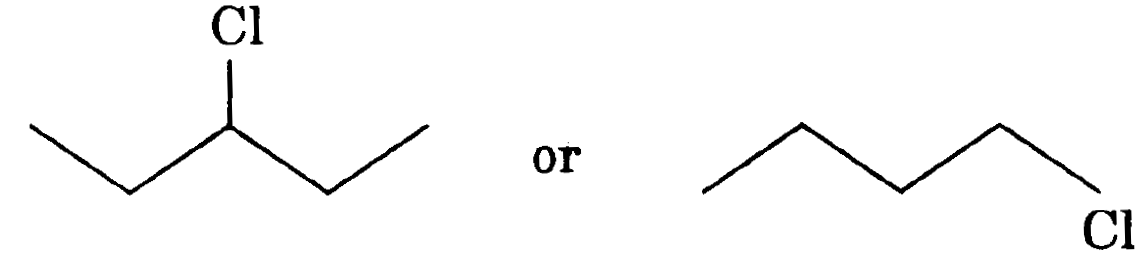
  2. Which one of the following two substances undergoes SN1 reaction faster and why?

Explain Rosenmund reduction in brief.
Give the structures of A, B and C in the following reaction:

$\text{CH}_3\text{COOH}\xrightarrow[\Delta]{\text{NH}_3}\text{A}\xrightarrow[]{\text{NaOBr}}\text{B}\xrightarrow[]{\text{NaNO}_2/\text{HCl}}\text{C}$