Question
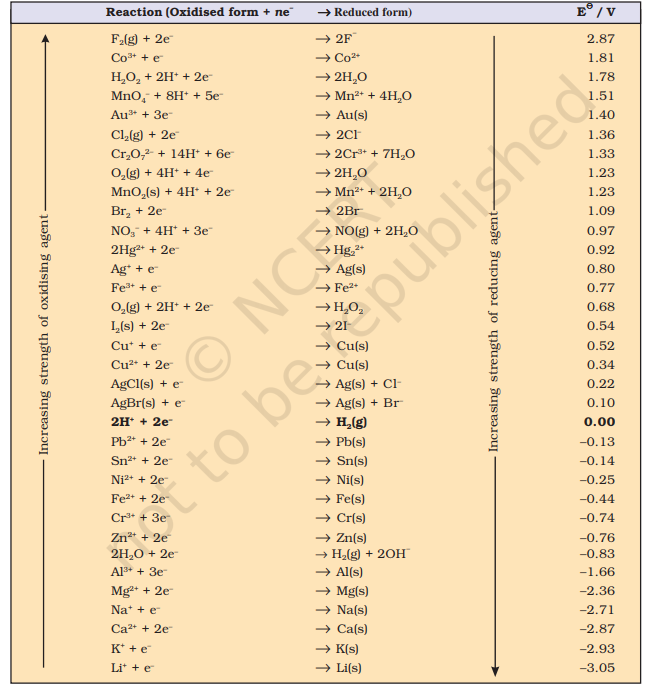
Using the standard electrode potentials given in the Table, predict if the reaction between the following is feasible:
Ag(s) and Fe3+(aq).

Answer

The possible reaction between Ag(s) and Fe3+(aq) is given by,

$\text{Ag}_{(\text{s})}+2\text{Fe}^{3+}_{(\text{aq})}\rightarrow\text{Ag}^{+}_{(\text{aq})}+\text{Fe}^{2+}_{(\text{aq})}$

$\text{Oxidation half equation:}\ \ \ \ \ \ \ \text{Ag}_{(\text{s})}\xrightarrow{\ \ \ \ \ \ }\text{Ag}^{+}_{(\text{aq})}+\text{e}^-;\ \ \text{E}^\circ=-0.80\text{V}\\\text{Reduction half equation:}\ \ \text{Fe}^{3+}_{(\text{aq})}+\text{e}^-\xrightarrow{\ \ \ \ \ }\text{Fe}^{2+}_{(\text{aq})};\ \ \ \ \ \ \ \ \text{E}^\circ=+0.77\text{V}\\\overline{\ \ \ \ \ \ \ \ \ \ \ \ \ \ \ \ \ \ \ \ \ \ \ \ \ \ \ \ \ \ \ \ \ \ \ \ \ \ \ \ \ \ \ \ \ \ \ \ \ \ \ \ \ \ \ \ \ \ \ \ \ \ \ \ \ \ \ \ \ \ \ \ \ \ \ \ \ \ \ \ \ \ \ \ \ \ \ \ \ \ \ \ \ \ \ \ \ \ \ \ \ \ \ \ \ \ \ \ \ \ \ \ \ \ \ \ \ \ }\\\ \ \ \ \ \ \ \ \ \ \ \ \ \ \ \ \ \ \ \ \ \ \ \ \ \ \ \ \ \ \ \ \ \text{Ag}^{}_{(\text{s})}+\text{Fe}^{3+}_{(\text{aq})}\xrightarrow{\ \ \ \ \ }\text{Ag}^{+}_{(\text{aq})}+\text{Fe}^{2+}_{(\text{aq})};\ \ \ \text{E}^\circ=-0.03\text{V}$

Here, E° for the overall reaction is negative. Hence, the reaction between Ag(s) and Fe3+(aq) is not feasible.

Need a full question paper?

Generate a complete, print-ready paper with questions like this in minutes — across 16+ boards, with answer keys.
Start Generating Free

Similar questions

Use Lewis symbols to show electron transfer between the following atoms to form cations and anions:
Al and N.
If 2 litres of N2 is mixed with 2 litres of H2 at a constant temperature and pressure, then what will be the volume of NHformed?
Predict the formulas of the stable binary compounds that would be formed by the combination of the following pairs of elements.
(a) Lithium and oxygen
(b) Magnesium and nitrogen
(c) Aluminium and iodine
(d) Silicon and oxygen
(e) Phosphorus and fluorine
(f) Element 71 and fluorine
For the following compound, write structural formulas and IUPAC names for all possible isomers having the number of double or triple bond as indicated:
C4H8 (one double bond).
Ethyl acetate is formed by the reaction between ethanol and acetic acid and the equilibrium is represented as :
$CH _3 COOH ( l )+ C _2 H _5 OH ( l ) \rightleftharpoons CH _3 COOC _2 H _5( l )$$+ H _2 O ( l )$
(i) Write the concentration ratio (reaction quotient) $Q_c$, for this reaction (note : water is not in excess and is not a solvent in this reaction).
(ii) At 293 K , if one starts with 1.00 mol of acetic acid and 0.18 mol of ethanol, there is 0.171 mol of ethyl acetate in the final equilibrium mixture. Calculate the equilibrium constant.
(iii) Starting with 0.5 mol of ethanol and 1.0 mol of acetic acid and maintaining it at $293 K, 0.214 mol$ of ethyl acetate is found after sometime. Has equilibrium been reached?
Cone. HCl is 38 % HCl by mass. What is the molarity of this solution if d = 1.19g cm-3? What volume of cone. HCl is required to make 1.00L of 0.10M HCl?
What is the maximum concentration of equimolar solutions of ferrous sulphate and sodium sulphide so that when mixed in equal volumes, there is no precipitation of iron sulphide? (For iron sulphide, $\left.K_{s p}=6.3 \times 10^{-18}\right)$
Find energy of each of the photons which,
Have wavelength of 0.50 $\mathring{\text{A}}.$
PbO and $PbO _2$ react with HCl according to the following chemical equations:
$
\begin{aligned}
& 2 PbO+4 HCl \rightarrow 2 PbCl_2+2 H_2 O \\
& PbO_2+4 HCl \rightarrow PbCl_2+Cl_2+2 H_2 O
\end{aligned}
$
Why do these compounds differ in their reactivity?