Question
Using the standard electrode potentials given in the Table, predict if the reaction between the following is feasible:
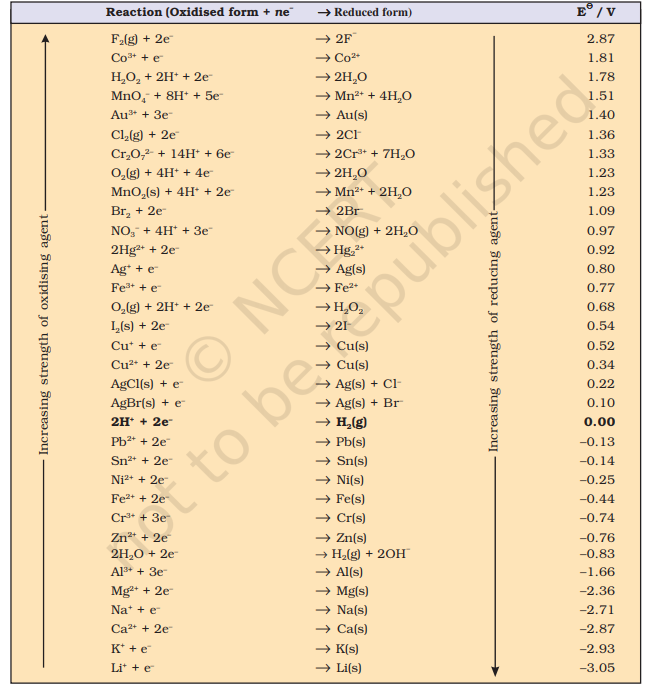
Br2(aq) and Fe2+(aq).

Answer

The possible reaction between Br2(aq) and Fe2+(aq) is given by,

$\text{Br}_{2(\text{s})}+2\text{Fe}^{2+}_{(\text{aq})}\rightarrow2\text{Br}^-_{(\text{aq})}+2\text{Fe}^{3+}_{(\text{aq})}$

$\text{Oxidation half equation:}\ \ \ \ \ \ \ \text{Fe}^{2+}_{(\text{aq})}\xrightarrow{\ \ \ \ \ \ }\text{Fe}^{3+}_{(\text{aq})}+\text{e}^-]\times2\ \ ;\text{E}^\circ=-0.77\text{V}\\\text{Reduction half equation:}\ \ \text{Br}^{}_{2(\text{aq})}+2\text{e}^-\xrightarrow{\ \ \ \ \ }2\text{Br}^{-}_{(\text{aq})}\ \ \ \ \ \ \ \ \ ; \text{E}^\circ=+1.09\text{V}\\\overline{\ \ \ \ \ \ \ \ \ \ \ \ \ \ \ \ \ \ \ \ \ \ \ \ \ \ \ \ \ \ \ \ \ \ \ \ \ \ \ \ \ \ \ \ \ \ \ \ \ \ \ \ \ \ \ \ \ \ \ \ \ \ \ \ \ \ \ \ \ \ \ \ \ \ \ \ \ \ \ \ \ \ \ \ \ \ \ \ \ \ \ \ \ \ \ \ \ \ \ \ \ \ \ \ \ \ \ \ \ \ \ \ \ \ \ \ \ \ \ \ \ }\\\ \ \ \ \ \ \ \ \ \ \ \ \ \ \ \ \ \ \ \ \ \ \ \ \ \ \text{Br}^{}_{2(\text{aq})}+2\text{Fe}^{2+}_{(\text{aq})}\xrightarrow{\ \ \ \ \ }2\text{Br}^{-}_{(\text{aq})}+2\text{Fe}^{3+}_{(\text{aq})}\ \ \ \ \ ;\text{E}^\circ=-0.32\text{V}$

Here, E° for the overall reaction is positive. Hence, the reaction between Br2(aq) and Fe2+(aq) is feasible.

Need a full question paper?

Generate a complete, print-ready paper with questions like this in minutes — across 16+ boards, with answer keys.

Start Generating Free

Similar questions

Which of the following pairs of elements would have a more negative electron gain enthalpy?
F or Cl
5.975g of the higher oxide of metal gave 5.575g of lower oxide on heating. The quantity of the lower oxide gave 5.175g of metal on reduction. Prove that these results are in accordance with the law of multiple proportions.
Describe the theory associated with the radius of an atom as it:
1. gains an electron
2. loses an electron
1 mole of an ideal gas undergoes reversible isothermal expansion from an initial volume of V1 to a final volume of 10V1 and does 10kJ of work. The initial pressure was 1 × 107Pa.
  1. Calculate V1.
  2. If there were 2 moles of gas, what must its temperature have been?
Emission transitions in the Paschen series end at orbit $n =3$ and start from orbit n and can be represeted as $v =$ $3.29 \times 10^{15}(Hz)\left[1 / 3^2-1 / n ^2\right]$ Calculate the value of n if the transition is observed at 1285 nm . Find the region of the spectrum.
Energy of an electron in the ground state of the hydrogen atom is –2.18×10⁻¹⁸J. Calculate the ionization enthalpy of atomic hydrogen in terms of J mol–1. 
Hint: Apply the idea of mole concept to derive the answer.
Which of the following reactions will get affected by increasing the pressure? Also, mention whether change will cause the reaction to go into forward or backward direction.
(i) $COCl _2(g) \rightleftharpoons CO ( g )+ Cl _2(g)$
(ii) $CH _4(g)+2 S_2(g) \rightleftharpoons CS _2(g)+2 H _2 S( g )$
(iii) $CO _2(g)+ C ( s ) \rightleftharpoons 2 CO ( g )$
(iv) $2 H _2(g)+ CO ( g ) \rightleftharpoons CH _3 OH ( g )$
(v) $CaCO _3(s) \rightleftharpoons CaO ( s )+ CO _2(g)$
(vi) $4 NH _3(g)+5 O _2(g) \rightleftharpoons 4 NO ( g )+6 H _2 O ( g )$
Find standard entropy change for the reaction $H _2(g)+ I _2(s) \rightarrow 2 HI ( g )$. If standard entropy of $I _2(S), H _2(g)$ and $HI ( g )$ are 116.7, 130.6 and 206.3 $JK ^{-1} mol^{-1}$ respectively. If values of $\Delta H ^{\circ}$ for this reaction is $+51.9 KJ mol ^{-1}$ then tell whether the reaction will occur spontaneously or not.
Choose the correct answer.
A reaction, A + B → C + D + q is found to have a positive entropy change. The reaction will be:
  1. Possible at high temperature.
  2. Possible only at low temperature.
  3. Not possible at any temperature.
  4. Possible at any temperature.
Why is the entropy of a substance taken as zero at 0K?

Calculate the standard Gibbs free energy change for the reaction:

$\text{N}_2(\text{g})+3\text{H}_2(\text{g})\rightleftharpoons2\text{NH}_3(\text{g})$ at 298K

The value of equilibrium constant for the above reaction is 6.6 × 10⁵. [R = 8.314J K-1mol-1]