Question
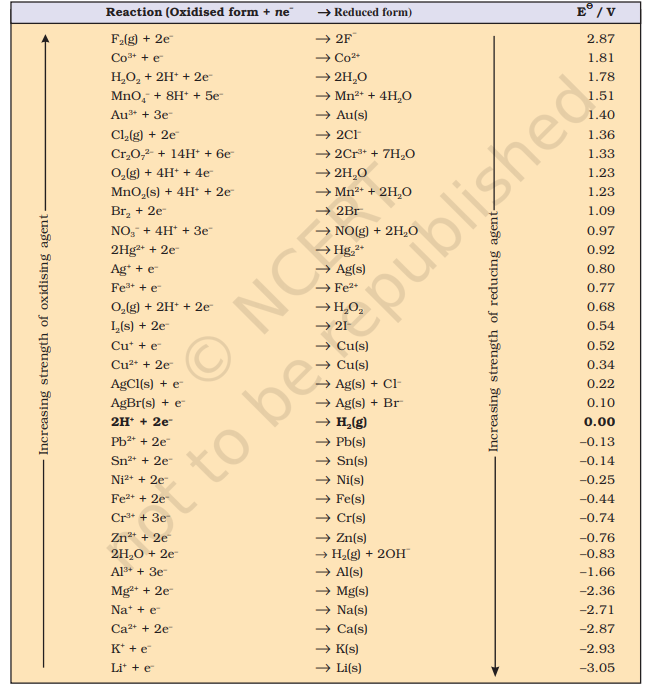
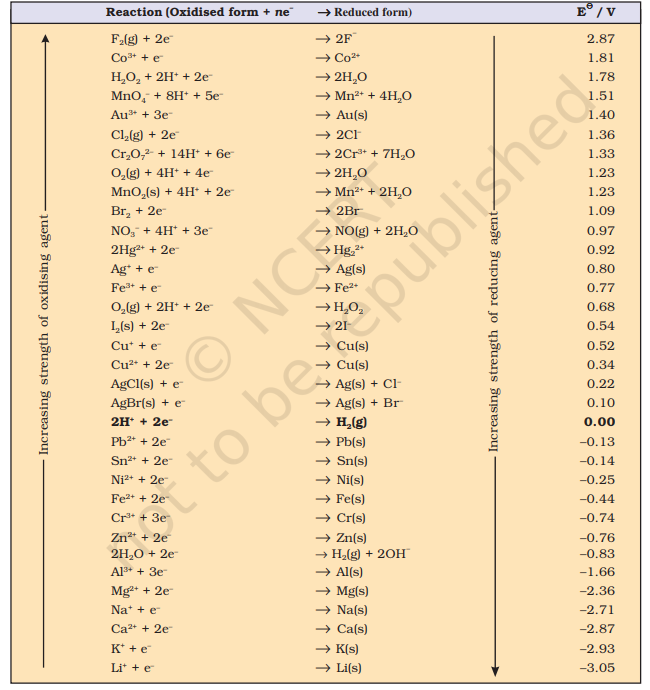
Using the standard electrode potentials given in the Table, predict if the reaction between the following is feasible:
Ag+(aq) and Cu(s).

Answer

The possible reaction between Ag+(aq) + Cu(s) is given by,

$2\text{Ag}^+_{(\text{aq})}+\text{Cu}_{(\text{s})}\rightarrow2\text{Ag}_{(\text{s})}+\text{Cu}^{2+}_{(\text{aq})}$

$\text{Oxidation half equation:}\ \ \ \ \ \ \ \ \text{Cu}_{(\text{s})}\xrightarrow{\ \ \ \ \ }\text{Cu}^{2+}_{(\text{aq})}+2\text{e}^-;\ \ \text{E}^\circ=-0.34\text{V}\\\text{Reduction half equation:}\ \ [\text{Ag}^+_{(\text{aq})}+\text{e}^-\xrightarrow{\ \ \ \ \ }\text{Ag}_{(\text{s})}]\times2;\ \ \ \text{E}^\circ=+0.80\text{V}\\\overline{\ \ \ \ \ \ \ \ \ \ \ \ \ \ \ \ \ \ \ \ \ \ \ \ \ \ \ \ \ \ \ \ \ \ \ \ \ \ \ \ \ \ \ \ \ \ \ \ \ \ \ \ \ \ \ \ \ \ \ \ \ \ \ \ \ \ \ \ \ \ \ \ \ \ \ \ \ \ \ \ \ \ \ \ \ \ \ \ \ \ \ \ \ \ \ \ \ \ \ \ \ \ \ \ \ \ \ \ \ \ \ \ \ \ \ \ \ \ }\\\ \ \ \ \ \ \ \ \ \ \ \ \ \ \ \ \ \ \ \ \ \ \ \ \ \ \ \ \ \ \ \ 2\text{Ag}^+_{(\text{aq})}+\text{Cu}_{(\text{s})}\xrightarrow{\ \ \ \ \ }2\text{Ag}_{(\text{s})}+\text{Cu}^{2+};\ \ \ \text{E}^\circ=+0.46\text{V}$

E° positive for the overall reaction is positive. Hence, the reaction between Ag+(aq) and Cu(s) is feasible.

Need a full question paper?

Generate a complete, print-ready paper with questions like this in minutes — across 16+ boards, with answer keys.

Start Generating Free

Similar questions

Identify the type of reactions:
  1. $\text{CH}_4+\text{Cl}_2\xrightarrow{\text{sunlight}}\text{CH}_3\text{Cl}+\text{HCl}$
  2. $\text{C}_6\text{H}_6+(\text{conc.})\text{HNO}_36\xrightarrow{\text{conc.}\text{H}_2\text{SO}_4}\text{C}_6\text{H}_5\text{NO}_2+\text{H}_2\text{O}$
  3. $ \ \ \ \ \ \ \ \ \ \ \ \ \ \ \ \ \ \ \ \ \ \ \ \ \ \ \ \ \ \ \ \ \ \ \ \ \ \ \ \ \ \ \ \ \ \ \ \ \ \ \ \ \ \ \ \ \ \ \ \ \ \ \ \ \ \text{Br}\\\ \ \ \ \ \ \ \ \ \ \ \ \ \ \ \ \ \ \ \ \ \ \ \ \ \ \ \ \ \ \ \ \ \ \ \ \ \ \ \ \ \ \ \ \ \ \ \ \ \ \ \ \ \ \ \ \ \ \ \ \ \ \ \ \ \ |\\\text{CH}_3-\text{CH}=\text{CH}_2+\text{HBr}\xrightarrow{\ \ \ \ \ \ \ }\text{CH}_3-\text{CH}-\text{CH}_3$
  4. $\ \ \ \ \ \ \ \ \ \ \ \ \ \text{O}\ \ \ \ \ \ \ \ \ \ \ \ \ \ \ \ \ \ \ \ \ \ \ \ \ \ \ \ \ \ \ \ \ \ \ \ \ \ \ \ \ \ \ \ \ \ \ \text{OH}\\\ \ \ \ \ \ \ \ \ \ \ \ \ \| \ \ \ \ \ \ \ \ \ \ \ \ \ \ \ \ \ \ \ \ \ \ \ \ \ \ \ \ \ \ \ \ \ \ \ \ \ \ \ \ \ \ \ \ \ \ \ \ \ \ |\\ \text{CH}_3-\text{C}-\text{CH}_3+\text{HCN}\xrightarrow{\ \ \ \ \ \ \ \ }\text{CH}_3-\text{C}-\text{CH}_3\\\ \ \ \ \ \ \ \ \ \ \ \ \ \ \ \ \ \ \ \ \ \ \ \ \ \ \ \ \ \ \ \ \ \ \ \ \ \ \ \ \ \ \ \ \ \ \ \ \ \ \ \ \ \ \ \ \ \ \ \ \ \ \ \ \ |\\\ \ \ \ \ \ \ \ \ \ \ \ \ \ \ \ \ \ \ \ \ \ \ \ \ \ \ \ \ \ \ \ \ \ \ \ \ \ \ \ \ \ \ \ \ \ \ \ \ \ \ \ \ \ \ \ \ \ \ \ \ \ \ \ \text{CN}$
  5. $\text{CH}_3-\text{CH}=\text{CH}_2\xrightarrow[\text{peroxide}]{\text{HBr}}\text{CH}_3\text{CH}_2\text{CH}_2\text{Br}$
  6. $\text{CH}_3\text{Cl}+\text{KOH}(\text{aq})\xrightarrow{\ \ \ \ \ \ \ \ \ }\text{CH}_3\text{OH}+\text{KCl}$
1. At $298 K, K _{ p }$ for the reaction $N _2 O _4(g) \rightleftharpoons 2 NO _2(g)$ is 0.98 . Predict whether the reaction is spontaneous or not.
2. Define specific heat.
3. State Hess's law.
1. Define intensive properties.
2. One mole of acetone requires less heat to vaporise than 1 mole of water. Which of the two liquids has the higher enthalpy of vaporisation?
3. Define standard enthalpy.
If 2L of N2 is mixed with 2L of H at a constant temperature and pressure, then what will be the volume of NH3 formed?
Yellow light emitted from a sodium lamp has a wavelength $(\lambda)$ of 580 nm. Calculate the frequency (ν) and wavenumber $(\bar{\text{v}})$ of the yellow light.
Use molecular orbital theory to explain why the Be2 molecule does not exist.
  1. How bond energy varies from $\text{N}^-_2$ to $\text{N}^+_2$ and why?
  2. On the basis of molecular orbital theory what is similarly between,
  1. $\text{F}_2\text{0}^{2-}_2$

  2. $\text{CO},\text{N}_2,\text{NO}^+?$

Calculate the energy and frequency of the radiation emitted when an electron jumps from n = 3 to n = 2 in a hydrogen atom.
Calculate the mass of sodium acetate (CH3COONa) required to make 500mL of 0.375 molar aqueous solution. Molar mass of sodium acetate is 82.0245 g mol-1.
Using the standard electrode potentials given in the Table, predict if the reaction between the following is feasible:

Fe3+(aq) and Cu(s).