Question
Using the standard electrode potentials given in the Table, predict if the reaction between the following is feasible:
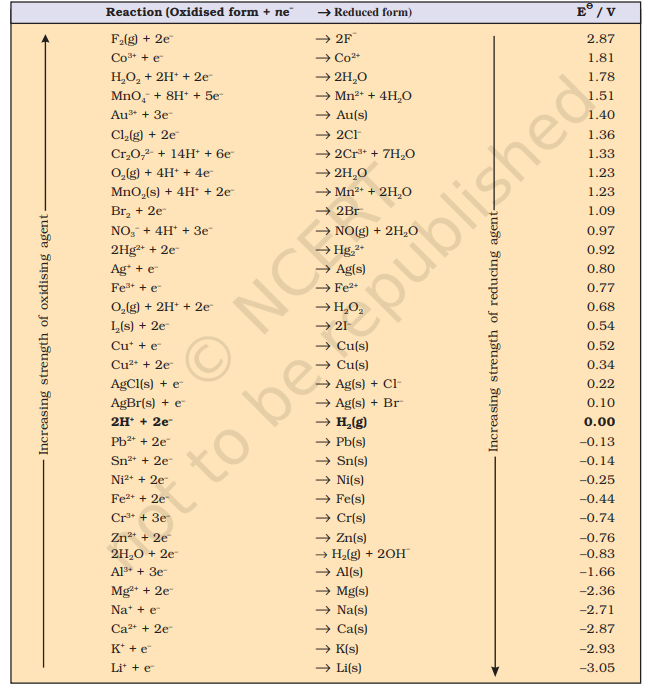
Ag(s) and Fe3+(aq).

Answer

The possible reaction between Ag(s) and Fe3+(aq) is given by,

$\text{Ag}_{(\text{s})}+2\text{Fe}^{3+}_{(\text{aq})}\rightarrow\text{Ag}^{+}_{(\text{aq})}+\text{Fe}^{2+}_{(\text{aq})}$

$\text{Oxidation half equation:}\ \ \ \ \ \ \ \text{Ag}_{(\text{s})}\xrightarrow{\ \ \ \ \ \ }\text{Ag}^{+}_{(\text{aq})}+\text{e}^-;\ \ \text{E}^\circ=-0.80\text{V}\\\text{Reduction half equation:}\ \ \text{Fe}^{3+}_{(\text{aq})}+\text{e}^-\xrightarrow{\ \ \ \ \ }\text{Fe}^{2+}_{(\text{aq})};\ \ \ \ \ \ \ \ \text{E}^\circ=+0.77\text{V}\\\overline{\ \ \ \ \ \ \ \ \ \ \ \ \ \ \ \ \ \ \ \ \ \ \ \ \ \ \ \ \ \ \ \ \ \ \ \ \ \ \ \ \ \ \ \ \ \ \ \ \ \ \ \ \ \ \ \ \ \ \ \ \ \ \ \ \ \ \ \ \ \ \ \ \ \ \ \ \ \ \ \ \ \ \ \ \ \ \ \ \ \ \ \ \ \ \ \ \ \ \ \ \ \ \ \ \ \ \ \ \ \ \ \ \ \ \ \ \ \ }\\\ \ \ \ \ \ \ \ \ \ \ \ \ \ \ \ \ \ \ \ \ \ \ \ \ \ \ \ \ \ \ \ \ \text{Ag}^{}_{(\text{s})}+\text{Fe}^{3+}_{(\text{aq})}\xrightarrow{\ \ \ \ \ }\text{Ag}^{+}_{(\text{aq})}+\text{Fe}^{2+}_{(\text{aq})};\ \ \ \text{E}^\circ=-0.03\text{V}$

Here, E° for the overall reaction is negative. Hence, the reaction between Ag(s) and Fe3+(aq) is not feasible.

Need a full question paper?

Generate a complete, print-ready paper with questions like this in minutes — across 16+ boards, with answer keys.

Start Generating Free

Similar questions

The increasing order of reactivity among group 1 elements is Li < Na < K < Rb <Cs, whereas that among group 17 elements is F > CI > Br > I. Explain.
  1. Consider the isoelectronic species, Na+, Mg2+, F- and O2-. What is the correct order of increasing length of their radii and why?
  2. Si is semiconductor whereas 'C' is non-metal, why?
At 473 K , equilibrium constant $K_c$ for decomposition of phosphorus pentachloride, $PCl _5$ is $8.3 \times 10^{-3}$. If decomposition is depicted as,
$PCl _5(g) \rightleftharpoons PCl _3(g)+ Cl _2(g) \Delta_{ r } H ^{\ominus}=124.0 kJ mol ^{-1}$
(a) Write an expression for $K_c$ for the reaction.
(b) What is the value of $K_c$ for the reverse reaction at the same temperature?
(c) What would be the effect on $K_c$ if (i) more $PCl _5$ is added (ii) pressure is increased (iii) the temperature is increased?
100mL of a liquid is contained in awn insulated container at a pressure of 1bar. The pressure is steeply increased to 100bar. The volume of the liquid is decreased by 1mL at this constant pressure. Find $\Delta\text{H}$ and $\Delta\text{U}.$
1. Give the mathematical expression of enthalpy.
2. Neither q nor W is a state function but $q + W$ is a state function. Explain why?
3. The standard heat of formation of $Fe _2 O _3$ (s) is $824.2 kJ mol ^{-1}$ Calculate heat change for the reaction.
$
4 Fe(s)+3 O_2(g) \rightarrow 2 Fe_2 O_3(s)
$
Write equation of following :
(i) Formation of ethyne from iodoform
(ii) Formation of but-2-yne from propyne with help of Grignard reagent
(iii) Addition of HBr with propyne in presence of peroxide
Use Lewis symbols to show electron transfer between the following atoms to form cations and anions:
Al and N.
Cone. HCl is 38 % HCl by mass. What is the molarity of this solution if d = 1.19g cm-3? What volume of cone. HCl is required to make 1.00L of 0.10M HCl?
PbO and $PbO _2$ react with HCl according to the following chemical equations:
$
\begin{aligned}
& 2 PbO+4 HCl \rightarrow 2 PbCl_2+2 H_2 O \\
& PbO_2+4 HCl \rightarrow PbCl_2+Cl_2+2 H_2 O
\end{aligned}
$
Why do these compounds differ in their reactivity?
In astronomical observations, signals observed from the distant starts are generally weak. If the photon detector receives a total of $=3.15 \times 10^{-18} J$ from the radiations of 600 nm . Calculate the number of photons received by the detector.