Question
Using vectors, prove that the parallelogram on the same base and between the same parallels are equal in area.
Answer

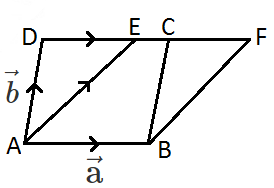
Let ABCD and ABFE are parallelograms on the same base AB and between the same parallel line AB and DF.

Let $\overrightarrow{\text{AB}}=\vec{\text{a}}$ and $\overrightarrow{\text{AD}}=\vec{\text{b}}$
$\therefore$ Area of parallelogram $\overrightarrow{\text{ABCD}}=\vec{\text{a}}\times\vec{\text{b}}$
Now, area of parallelogram of $\overrightarrow{\text{ABFE}}=\overrightarrow{\text{AB}}\times\overrightarrow{\text{AE}}$
$=\overrightarrow{\text{AB}}\times(\overrightarrow{\text{AD}}+\overrightarrow{\text{DE}})$
$=\overrightarrow{\text{AB}}\times(\vec{\text{b}}+\text{k}\vec{\text{a}})$ $[\text{let}\overrightarrow{\text{ DE}}=\text{k}\vec{\text{a}},\text{where k is a scalar}]$ 
$=\vec{\text{a}}\times(\vec{\text{b}}+\text{k}\vec{\text{a}})$
$=(\vec{\text{a}}\times\vec{\text{b}})+(\vec{\text{a}}\times\text{k}\vec{\text{a}})$
$=(\vec{\text{a}}\times\vec{\text{b}})+\text{k}(\vec{\text{a}}\times\vec{\text{a}})$
$=(\vec{\text{a}}\times\vec{\text{b}})\ [\because\vec{\text{a}}\times\vec{\text{a}}=0]$
Area of parallelogram ABCD.
Hence proved.

Need a full question paper?

Generate a complete, print-ready paper with questions like this in minutes — across 16+ boards, with answer keys.

Start Generating Free

Similar questions

Show that the points (2, 3, 4), (-1, -2, 1), (5, 8, 7) are collinear.
Find the distance of the point (- 1, - 5, - 10), from the point of intersection of the line
$\overrightarrow{\text{r}}=(2\hat{\text{i}}-\hat{\text{j}}+2\hat{\text{k})}+\lambda(3\hat{\text{i}}+4\hat{\text{j}}+2\hat{\text{k})}\text{ and the plane}\overrightarrow{\text{r}}\cdot(\hat{\text{i}}-\hat{\text{j}}+\hat{\text{k})}=5.$
If $\tan^{-1}\Big(\frac{\text{x}^2-\text{y}^2}{\text{x}^2+\text{y}^2}\Big)=\text{a}$ prove that $\frac{\text{dx}}{\text{dx}}=\frac{\text{y}}{\text{x}}\frac{(1-\tan\text{a})}{(1+\tan\text{a})}$
In a class, 5% of the boys and 10% of the girls have an IQ of more than 150. In this class, 60% of the students are boys. If a student is selected at random and found to have an IQ of more than 150, find the probability that the student is a boy.
Evaluate :
$
\int_{-\pi}^\pi \frac{2 x(1+\sin x)}{1+\cos ^2 x} d x
$
Evaluate the following integrals:
$\int^\limits{\pi}_0\sin^3\text{x}(1+2\cos\text{x})(1+\cos\text{x})^2\text{ dx}$
Evaluate the following integrals:
$\int_{0}^\limits{\frac{\pi}{2}}\frac{\sin\text{x}\cos\text{x}}{1+\sin^4\text{x}}\text{ dx}$
Solve the following differential equation:

$4\frac{\text{dy}}{\text{dx}}+8\text{y}=5\text{e}^{-3\text{x}}$

Evaluate the following intregals:
$\int\frac{1}{5+7\cos\text{x}+\sin\text{x}}\ \text{dx}$
Solve the differential equation $\left( {\frac{{{e^{ - 2\sqrt x }}}}{{\sqrt x }} - \frac{y}{{\sqrt x }}} \right)\frac{{dx}}{{dy}}$ = 1 (x $\neq$ 0)