Question
Using vectors, prove that the parallelogram on the same base and between the same parallels are equal in area.

Answer

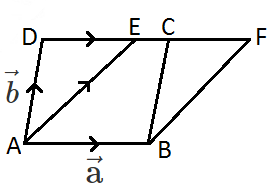
Let ABCD and ABFE are parallelograms on the same base AB and between the same parallel line AB and DF.

Let $\overrightarrow{\text{AB}}=\vec{\text{a}}$ and $\overrightarrow{\text{AD}}=\vec{\text{b}}$
$\therefore$ Area of parallelogram $\overrightarrow{\text{ABCD}}=\vec{\text{a}}\times\vec{\text{b}}$
Now, area of parallelogram of $\overrightarrow{\text{ABFE}}=\overrightarrow{\text{AB}}\times\overrightarrow{\text{AE}}$
$=\overrightarrow{\text{AB}}\times(\overrightarrow{\text{AD}}+\overrightarrow{\text{DE}})$
$=\overrightarrow{\text{AB}}\times(\vec{\text{b}}+\text{k}\vec{\text{a}})$ $[\text{let}\overrightarrow{\text{ DE}}=\text{k}\vec{\text{a}},\text{where k is a scalar}]$
$=\vec{\text{a}}\times(\vec{\text{b}}+\text{k}\vec{\text{a}})$
$=(\vec{\text{a}}\times\vec{\text{b}})+(\vec{\text{a}}\times\text{k}\vec{\text{a}})$
$=(\vec{\text{a}}\times\vec{\text{b}})+\text{k}(\vec{\text{a}}\times\vec{\text{a}})$
$=(\vec{\text{a}}\times\vec{\text{b}})\ [\because\vec{\text{a}}\times\vec{\text{a}}=0]$
Area of parallelogram ABCD.
Hence proved.

Need a full question paper?

Generate a complete, print-ready paper with questions like this in minutes — across 16+ boards, with answer keys.
Start Generating Free

Similar questions

In a bulb factory, machines A, B and C manufacture $60 \%, 30 \%$ and $10 \%$ bulbs respectively. $1 \%, 2 \%$ and $3 \%$ of the bulbs produced respectively by $\mathrm{A}, \mathrm{B}$ and C are found to be defective. A bulb is picked up at random from the total production and found to be defective. Find the probability that this bulb was produced by the machine A.
Show that the lines $\frac{\text{x}}{1}=\frac{\text{y}-2}{2}=\frac{\text{z}+3}{3}$ and $\frac{\text{x}-2}{2}=\frac{\text{y}-6}{3}=\frac{\text{z}-3}{4}$ intersect and find their point of intersection.
cards are drawn successively with replacement from a well shuffled pack of 52 cards. Find the mean and variance of red cards.
If $\text{y}=\text{e}^{\text{x}^2\cos\text{x}}+(\cos\text{x})^{\text{x}}, $ then find $\frac{\text{dy}}{\text{dx}}.$
The function $y = a$ log $x + bx^2 + x$ has extreme values at $x = 1$ and $x = 2$. Find a and b.
Show that the line whose vector equation is $\vec{\text{r}}=2\hat{\text{i}}+5\hat{\text{j}}+7\hat{\text{k}}+\lambda(\hat{\text{i}}+3\hat{\text{j}}+4\hat{\text{k}})$ is parallel to the plane whose vector equation is $\vec{\text{r}}\cdot(\hat{\text{i}}+\hat{\text{j}}-\hat{\text{k}})=7$ Also, find the distance between thetm.
Prove that the curves $\text{y}^{2} = 4x \text{ and } x^{2} = 4y $ divided the area of square bounded by $x = 0, x = 4,y=4 \text{ and } y = 0$ into three equal parts.
Find the equations of the tangent and the normal to the following curves at the indicated points.
$\frac{\text{x}^2}{\text{a}^2}-\frac{\text{y}^2}{\text{b}^2}=1\text{at}(\sqrt{2}\text{a},\text{b})$
Verify the Rolle’s theorem for each of the functions:
$\text{f(x)}=\sqrt{4-\text{x}^2}\text{ in }[-2,2].$
Find the image of the point with position vector $3\hat{\text{i}}+\hat{\text{j}}+2\hat{\text{k}}$ in the plane $\vec{\text{r}}. (2\hat{\text{i}}-\hat{\text{j}}+\hat{\text{k}})=4.$ Also, find the position vectors of the foot of the prependicular and the equation of the perpendicular line through $3\hat{\text{i}}+\hat{\text{j}}+2\hat{\text{k}}.$