MCQ
$V$ (stopping potential) is plotted against $\frac{1}{\lambda}$, where $\lambda$ is wavelength of incident radiations, for two metals
  • A
    Metal $1$ may be gold and metal $2$ may be cesium
  • B
    $\theta_1 > \theta_2$, if metal $-1$ is gold and metal- $2$ is cesium
  • $\theta_1=\theta_2$, for any two metals
  • D
    $\theta_1 > \theta_2$, if metal $-1$ and metal- $2$ are gold and copper respectively
Answer

Correct option: C.
$\theta_1=\theta_2$, for any two metals
c
(c)

$\frac{h c}{\lambda}=\frac{h c}{632.2 \times 10^{-9}}$

$\frac{h c}{\lambda}=e V+w_0$

$e V=\frac{h c}{\lambda}-w_0$

$V=\frac{h c}{e} \times \frac{1}{\lambda}-\frac{w_0}{e}$

$\tan \theta=\frac{h c}{e}=$ constant [Slope of $V$ vs $\frac{1}{\lambda}$ graph]

$\therefore \theta$ is same for all metals.

Need a full question paper?

Generate a complete, print-ready paper with questions like this in minutes — across 16+ boards, with answer keys.

Start Generating Free

Similar questions

Energy released in fusion of 1 kg of deuterium nuclei
The magnetic flux through a stationary loop with resistance $R$ varies during interval of time $T$ as $\phi=a t(T-t)$. The heat generated during this time neglecting the inductance of loop will be
The diameter of the pupil of human eye is about $2\,mm$. Human eye is most sensitive to the wavelength of $555\, nm$. The limit of resolution of human eye is.......$min$
A nucleus with $Z = 92$  emits the following in a sequence $:\,\alpha ,\,\alpha ,\,{\beta ^ - },{\beta ^ - },\alpha ,\,\alpha ,\alpha ,\,\alpha ,{\beta ^ - },{\beta ^ - },\alpha ,{\beta ^ - },{\beta ^ - },\alpha .$The $Z$  of the resulting nucleus is
Let V and H be the vertical and horizontal components of earth's magnetic field at any point on earth. Near the north pole
In a triode valve
The magnetic field at the centre of a circular coil of radius r carrying current I is $B_1$. The field at the centre of another coil of radius 2 r carrying same current I is $B_2$. The ratio $\frac{B_1}{B_2}$ is
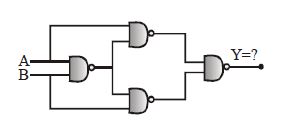
Select the outputs $Y$ of the combination of gates shown below for inputs $A = 0, B = 0; A = 1$, $B = 1$ and $A = 0, B = 1$ respectively
Which of the following statement$(s)$ is/are true about holes?
A silicon speciman is made into a $P-$type semi-conductor by dopping, on an average, one Indium atom per $5 \times {10^7}$silicon atoms. If the number density of atoms in the silicon specimen is $5 \times {10^{28}}{\rm{atoms}}/{m^3}$ then the number of acceptor atoms in silicon per cubic centimetre will be