MCQ
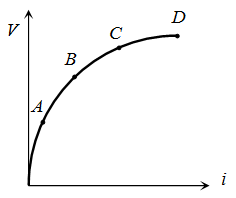
Variation of current passing through a conductor as the voltage applied across its ends as varied is shown in the adjoining diagram. If the resistance (R) is determined at the points A, B, C and D, we will find that
  • A
    $R_C = R_D$
  • B
    $R_B > R_A$
  • C
    $R_C > R_B$
  • None of these

Answer

Correct option: D.
None of these
(d) None of these

Need a full question paper?

Generate a complete, print-ready paper with questions like this in minutes — across 16+ boards, with answer keys.

Start Generating Free

Similar questions

Voltage across each elements of a series $\text{LCR}$ circuit are given by $V_L=60 V, VC =20 V, V _{ R }=30 V$ Find out source voltage.
The correct match between the entries in column $I$ and column $II$ are 

            $I$                         $(II)$

Radiation                     Wavelength

$(a)$ Microwave          $(i)$ $100 m$

$(b)$ Gamma rays      $(ii)$ $10^{-15} m$

$(c)$ $A.M.$ radio waves        $(iii)$ $10^{-10} m$

$(d)$ $X-$rays             $(iv)$ $10^{-3} m$

If the highest frequency modulating a carrier is $5\, kHz ,$ then the number of $AM$ broadcast stations accommodated in a $90\, kHz$ bandwidth are ....... .
An electron having charge ‘e’ and mass ‘m’ is moving in a uniform electric field E. Its acceleration will be
The dimensions of magnetic flux are
$_{86}{A^{222}}{ \to _{84}}{B^{210}}$. In this reaction how many $\alpha $ and $\beta $ particles are emitted
In Young’s double slit experiment the amplitudes of two sources are 3a and a respectively. The ratio of intensities of bright and dark fringes will be
Light wave is travelling along $y -$ direction. If the corresponding $E$ vector at any time along the $x -$ axis, the direction of $B$ vector at that time is along.
Image
Two or more resistors are said to be in $...A...$ if one end of all resistors is joined together and similarly the other ends joined together, Here, A refers to:
Eight copper wire of length $l$ and diameter $d$ are joined in parallel to form a single composite conductor of resistance $R$. If a single copper wire of length $2\,l$ have the same resistance $(R)$ then its diameter will be $.....d$.