MCQ
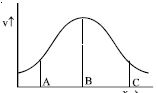
Variation of electrostatic potential along $x$-direction is shown in the graph. The correct statement about electric field is
  • A
    $x$ component at point $B$ is maximum
  • B
    $x $ component at point $A$ is towards positive $x$-axis.
  • C
    $x$ component at point $C$ is along negative $x-$ axis
  • $x $ component at point $C$ is along positive $x$ -axis
Answer

Correct option: D.
$x $ component at point $C$ is along positive $x$ -axis
d
Electric field $E_{x}=-\frac{d V}{d x} .$ So for negative slope, field will be directed along positive $x$. Thus $x$ component at point $A$ is towards negative $x$ $-axis$ and $x$ component at point $C$ is along positive $x$ $-axis$ and at point $B, x$ $-component$ of field will be minimum.

Need a full question paper?

Generate a complete, print-ready paper with questions like this in minutes — across 16+ boards, with answer keys.

Start Generating Free

Similar questions

An ice cube of dimensions $60\,cm \times 50\,cm \times 20\,cm$ is placed in an insulation box of wall thickness $1\,cm$. The box keeping the ice cube at $0^{\circ}\,C$ of temperature is brought to a room of temperature $40^{\circ}\,C$. The rate of melting of ice is approximately. (Latent heat of fusion of ice is $3.4 \times 10^{5}\,J\,kg ^{-1}$ and thermal conducting of insulation wall is $0.05\,Wm ^{-10} C ^{-1}$ )
A boy playing on the roof of a $10\, m$ high building throws a ball with a speed of $10\, m/s$ at an angle $30^o$ with the horizontal. ........ $m$ far from the throwing point will the ball be at the height of $10\, m$ from the ground . $(g \,= \,10 m/s^2, \,sin \,30^o \,= \,\frac{1}{2}$, $\cos \,{30^o}\, = \,\frac{{\sqrt 3 }}{2}$)
For a projectile the ratio of maximum height reached to the square of flight time is
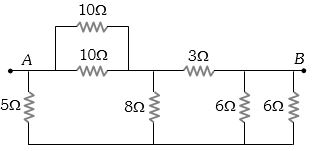
Seven resistances are connected as shown in the figure. The equivalent resistance between $A$ and $B$ is ............... $\Omega$
A particle is projected upwards. The times corresponding to height $h$ while ascending and while descending are $t‌‌_1$ and $t_2$ respectively. The velocity of projection will be
In a steady state of thermal conduction, temperature of the ends $A$ and $B$ of a $20\, cm$ long rod are ${100^o}C$ and ${0^o}C$ respectively. What will be the temperature of the rod at a point at a distance of $6$ cm from the end $A$ of the rod....... $^oC$
Two polaroids are placed in the path of unpolarized beam of intensity $I_0$ such that no light is emitted from the second polaroid. If a third polaroid whose polarization axis makes an angle $\theta $ with the polarization axis of first polaroid, is placed between these polaroids, then the intensity of light emerging from the last polaroid will be 
A certain amount of gas is taken through a cyclic process $(A\,B\,C\,D\,A)$  that has two isobars, one isochore and one isothermal. The cycle can be represented on a $P-V$ indicator diagram as
Stars are twinkling due to
Particle $A$ of mass $m _{1}$ moving with velocity $(\sqrt{3} \hat{i}+\hat{j})\, ms ^{-1}$ collides with another particle $B$ of mass $m _{2}$ which is at rest initially. Let $\overrightarrow{ V }_{1}$ and $\overrightarrow{ V }_{2}$ be the velocities of particles $A$ and $B$ after collision respectively. If $m _{1}=2\, m _{2}$ and after collision $\overrightarrow{ V }_{1}=(\hat{ i }+\sqrt{3} \hat{ j })\, ms ^{-1},$ the angle between $\overrightarrow{ V }_{1}$ and $\overrightarrow{ V }_{2}$ is$......^o$