MCQ
$\vec{a}+\vec{b}+\vec{c}=0$ such that $|\vec{a}|=3,|\vec{b}|=5$ and $|\vec{c}|=7$.
What is the angle between $\vec{a}$ and $\vec{b}$ ?
  • A
    $\frac{\pi}{3}$
  • B
    $\frac{\pi}{2}$
  • C
    $\frac{\pi}{4}$
  • D
    $\frac{\pi}{6}$

Answer

(a) $\frac{\pi}{3}$
Explanation: $\frac{\pi}{3}$

Need a full question paper?

Generate a complete, print-ready paper with questions like this in minutes — across 16+ boards, with answer keys.

Start Generating Free

Similar questions

Choose the correct answer
If $\theta$ is the angle between any two vectors $\vec{\text{a}}\ \text{and}\ \vec{\text{b}}, \text{then}\ |\vec{\text{a}}\cdot\vec{\text{b}}|=|\vec{\text{a}}\times\vec{\text{b}}|\ \text{when}\ \theta$ is equal to
Area enclosed between the curve $y^2(2a - x) = x^3$ and the line $x = 2a$ above $x-$ axis is:
Mark the correct alternative in the following question : Suppose a random variable $X$ follows the binomial distribution with parameters $n$ and $p,$ where $0 < p < 1.$ If $\frac{\text{P(X = r})}{\text{P(X = n} -\text{r})}$ is independent of $n$ and $r,$ then $p$ equals :
The value of $\tan^{-1}\Big(\frac{1}{2}\Big)+\tan^{-1}\Big(\frac{1}{3}\Big)+\tan^{-1}\Big(\frac{7}{8}\Big)$ is:
Linear programming model which involves funds allocation of limited investment is classified as:
$\int_{\,0}^{\,2\pi } {(\sin x + |\sin x|)\,dx = } $
${d \over {dx}}\{ {e^{ - a{x^2}}}\log (\sin x)\} = $
Let $f, g$ and $h$ be real-valued functions defined on the interval $[0,1]$ by $f(x)=e^{x^2}+e^{-x^2}, g(x)$ $=x e^{x^2}+e^{-x^2}$ and $h(x)=x^2 e^{x^2}+e^{-x^2}$. If $a, b$ and $c$ denote, respectively, the absolute maximum of $f, g$ and $\mathrm{h}$ on $[0,1]$, then
Integration factor of differential equation $\frac{\text{dy}}{\text{dx}}+\text{py}=\text{Q},$ where $P$ and $IQ$ are functions of $x$ is:
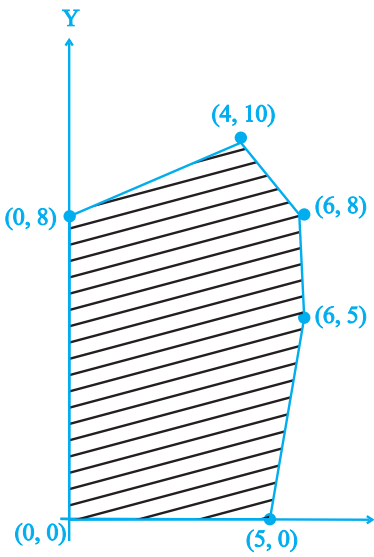
Choose the correct answer from the given four options. The feasible solution for a LPP is shown in. Let Z = 3x - 4y be the objective function.
Maximum of Z occurs at: