MCQ
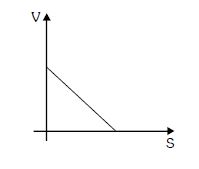
Velocity-displacement graph of a particle moving in a straight line is as shown in figure
  • A
    magnitude of acceleration of particle is constant
  • B
    magnitude of acceleration of particle is increasing
  • acceleration versus displacement graph is straight line
  • D
    acceleration versus displacement graph is parabola

Answer

Correct option: C.
acceleration versus displacement graph is straight line
c
$\mathrm{V}=-\mathrm{mS}+\mathrm{V}_{0}$

$\left(\frac{d V}{d S}\right)=-m$

$a=V\left(\frac{d V}{d S}\right)=\left[-m S+V_{0}\right][-m]$

$\mathrm{a}=\mathrm{m}^{2} \mathrm{S}-\mathrm{m} \mathrm{V}_{0}$

This is eqn. of straight line.

Need a full question paper?

Generate a complete, print-ready paper with questions like this in minutes — across 16+ boards, with answer keys.

Start Generating Free

Similar questions

A bullet is fired from a gun at the speed of $280\,ms ^{-1}$ in the direction $30^{\circ}$ above the horizontal. The maximum height attained by the bullet is $........\,m$ $\left(g=9.8\,ms ^{-2}, \sin 30^{\circ}=0.5\right):-$
The ratio of the radius of gyration of a thin uniform disc about an axis passing through its centre and normal to its plane to the radius of gyration of the disc about its diameter is
Write the dimensions of $a/b$ in the relation $P = \frac{{a - {t^2}}}{{bx}}$ , where $P$ is pressure, $x$ is the distance and $t$ is the time 
A machine is blowing spherical soap bubbles of different radii filled with helium gas.It is found that, if the bubbles have a radius smaller than $1\,cm$, then they sink to the floor in still air. Larger bubbles float in the air. Assume that the thickness of the soap film in all bubbles is uniform and equal. Assume that the density of soap solution is same as that of water $\left(=1000 \,kg m ^{-3}\right)$. The density of helium inside the bubbles and air are $0.18 \,kg m ^{-3}$ and $1.23 \,kg m ^{-3}$, respectively. Then, the thickness of the soap film of the bubbles is .......... $\mu m$ (Note $1 \,\mu m =10^{-6} \,m$ )
Consider a Vernier callipers in which each $1 \ cm$ on the main scale is divided into $8$ equal divisions and a screw gauge with $100$ divisions on its circular scale. In the Vernier callipers, $5$ divisions of the Vernier scale coincide with $4$ divisions on the main scale and in the screw gauge, one complete rotation of the circular scale moves it by two divisions on the linear scale. Then:

$(A)$ If the pitch of the screw gauge is twice the least count of the Vernier callipers, the least count of the screw gauge is $0.01 \ mm$.

$(B)$ If the pitch of the screw gauge is twice the least count of the Vernier callipers, the least count of the screw gauge is $0.005 \ mm$.
$(C)$ If the least count of the linear scale of the screw gauge is twice the least count of the Vernier callipers, the least count of the screw gauge is $0.01 \ mm$.

$(D)$ If the least count of the linear scale of the screw gauge is twice the least count of the Vernier callipers, the least count of the screw gauge is $0.005 \ mm$.

Three blocks of masses $m_1=4 \,kg , m_2=2 \,kg , m_3=4 \,kg$ are connected with ideal strings passing over a smooth. massless pulley as shown in figure. The acceleration of blocks will be ......... $m / s ^2$ $\left(g=10 \,m / s ^2\right)$
A solid cylinder rolls down an inclined plane from a height $h$. At any moment the ratio of rotational kinetic energy to the total kinetic energy would be 
A measure of the degree of disorder of a system is known as
Correct formula for height of a satellite from earths surface is :
In the Young’s experiment, If length of wire and radius both are doubled then the value of $Y$ will become