MCQ
Velocity of center of mass in the absence of external force
  • A
    zero
  • constant
  • C
    will increase
  • D
    will decrease

Answer

Correct option: B.
constant
B
 In the absence of external force the velocity of the center of mass remains constant.

Need a full question paper?

Generate a complete, print-ready paper with questions like this in minutes — across 16+ boards, with answer keys.
Start Generating Free

Similar questions

A truck has a velocity of $2 m / s$ at time $t=0$. It accelerates at $2 m / s ^2$ on seeing police. What is its velocity in $m / s$ at a time of 2 sec ?
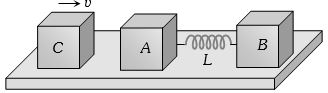
Two blocks $A$ and $B$ each of mass m are connected by a massless spring of natural length L and spring constant $K$. The blocks are initially resting on a smooth horizontal floor with the spring at its natural length as shown in figure. A third identical block $C$ also of mass $m$ moves on the floor with a speed $v$ along the line joining $A$ and $B$ and collides with $A$. Then
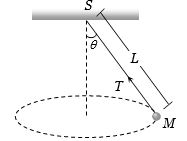
A string of length $L$ is fixed at one end and carries a mass $M$ at the other end. The string makes $2/\pi$ revolutions per second around the vertical axis through the fixed end as shown in the figure, then tension in the string is
An engine has an efficiency of $\frac16$ when the temperature of sink is reduced by $62^\circ C,$ its efficiency is doubled, temperature of the source is:
At ...... $ ^o C$ temperature, the mean kinetic energy of ${O_2}$ will be the same for ${H_2}$ molecules at $- 73^o C$
Three bodies having masses $5\, kg , 4\, kg$ and $2 \,kg$ is moving at the speed of $5\, m / s , 4\, m / s$ and $2 \,m / s$ respectively along $X -$axis. The magnitude of velocity of centre of mass is (in $m/s$)
A simple pendulum with a metallic bob has a time period $T$. The bob is now immersed in a non-viscous liquid and oscillated. If the density of the liquid is $1 / 4$ that of metal, the time period of the same pendulum will be ...........
A camet (assumed to be in an elliptical orbit around the sun) is at a distance of $0.4 \,AU$ from the sun at the perihelion. If the time period of the camet is $125 \,yr$.the aphelion distance is ........... $AU$ ($AU$ : Astronomical Unit)
$A$ particle with constant total energy $E$ moves in one dimension in a region where the potential energy is $U(x)$. The speed of the particle is zero where
A length-scale $(l)$ depends on the permittivity $(\varepsilon)$ of a dielectric material. Boltzmann constant $\left(k_B\right)$, the absolute temperature $(T)$, the number per unit volune $(n)$ of certain charged particles, and the charge $(q)$ carried by each of the particless. Which of the following expression($s$) for $l$ is(are) dimensionally correct?

($A$) $l=\sqrt{\left(\frac{n q^2}{\varepsilon k_B T}\right)}$

($B$) $l=\sqrt{\left(\frac{\varepsilon k_B T}{n q^2}\right)}$

($C$)$l=\sqrt{\left(\frac{q^2}{\varepsilon n^{2 / 3} k_B T}\right)}$

($D$) $l=\sqrt{\left(\frac{q^2}{\varepsilon n^{1 / 3} k_B T}\right)}$