Velocity of sound in air
$I.$ Increases with temperature
$II.$ Decreases with temperature
$III.$ Increase with pressure
$IV.$ Is independent of pressure
$V.$ Is independent of temperature
Choose the correct answer.
Easy
Download our app for free and get started
(d) Speed of sound $v \propto \sqrt T $ and it is independent of pressure.

Download our appand get started for free
Experience the future of education. Simply download our apps or reach out to us for more information. Let's shape the future of learning together!No signup needed.*
Similar Questions
- 1The velocity of waves in a string fixed at both ends is $2 m/s$. The string forms standing waves with nodes $5.0 cm$ apart. The frequency of vibration of the string in $Hz$ isView Solution
- 2Stationary waves are set up in air column. Velocity of sound in air is $330 m/s$ and frequency is $165\,Hz$. Then distance between the nodes is ... $m$View Solution
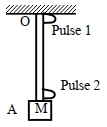
- 3A block $\mathrm{M}$ hangs vertically at the bottom end of a uniform rope of constant mass per unit length. The top end of the rope is attached to a fixed rigid support at $O$. A transverse wave pulse (Pulse $1$ ) of wavelength $\lambda_0$ is produced at point $O$ on the rope. The pulse takes time $T_{O A}$ to reach point $A$. If the wave pulse of wavelength $\lambda_0$ is produced at point $A$ (Pulse $2$) without disturbing the position of $M$ it takes time $T_{A 0}$ to reach point $O$. Which of the following options is/are correct?View Solution
(image)
[$A$] The time $\mathrm{T}_{A 0}=\mathrm{T}_{\mathrm{OA}}$
[$B$] The velocities of the two pulses (Pulse $1$ and Pulse $2$) are the same at the midpoint of rope.
[$C$] The wavelength of Pulse $1$ becomes longer when it reaches point $A$.
[$D$] The velocity of any pulse along the rope is independent of its frequency and wavelength.
- 4The tension in a wire is decreased by $19 \%$. The percentage decrease in frequency will be ......... $\%$View Solution
- 5Velocity of sound waves in air is $330\; m/sec$. For a particular sound in air, a path difference of $40 \;cm$ is equivalent to a phase difference of $1.6 \pi$. The frequency of this wave is... $Hz$View Solution
- 6Tone $A$ has frequency of $240 Hz.$ Of the following tones, the one which will sound least harmonious with $A$ isView Solution
- 7A string fixed at one end is vibrating in its second overtone. The length of the string is $10\ cm$ and maximum amplitude of vibration of particles of the string is $2\ mm$ . Then the amplitude of the particle at $9\ cm$ from the open end isView Solution
- 8A closed organ pipe has a fundamental frequency of $1.5\, kHz$. The number of overtones that can be distinctly heard by a person with this organ pipe will be : (Assume that the highest frequency a person can hear is $20,000\, Hz$)View Solution
- 9A source and an observer are moving towards each other with a speed equal to $\frac{v}{2}$ where $v$ is the speed of sound. The source is emitting sound of frequency $n$. The frequency heard by the observer will beView Solution
- 10A closed organ pipe of length $L$ and an open organ pipe contain gases of densities $\rho_{1}$ and $\rho_{2}$ respectively. The compressibility of gases are equal in both the pipes. Both the pipes are vibrating in their first overtone with same frequency. The length of the open pipe is $\frac{ x }{3} L \sqrt{\frac{\rho_{1}}{\rho_{2}}}$ where $x$ is ......... . (Round off to the Nearest Integer)View Solution