Velocity of sound in air
$I.$ Increases with temperature
$II.$ Decreases with temperature
$III.$ Increase with pressure
$IV.$ Is independent of pressure
$V.$ Is independent of temperature
Choose the correct answer.
Easy


Download our appand get started for free
Experience the future of education. Simply download our apps or reach out to us for more information. Let's shape the future of learning together!No signup needed.*
Similar Questions
- 1A composition string is made up by joining two strings of different masses per unit length $\rightarrow \mu$ and $4\mu$ . The composite string is under the same tension. A transverse wave pulse $: Y = (6 mm) \,\,sin\,\,(5t + 40x),$ where $‘t’$ is in seconds and $‘x’$ in meters, is sent along the lighter string towards the joint. The joint is at $x = 0$. The equation of the wave pulse reflected from the joint isView Solution
- 2The ratio of intensities between two coherent soud sources is $4 : 1$. The differenmce of loudness in $dB$ between maximum and minimum intensities when they interfere in space is:View Solution
- 3View Solution“Stationary waves” are so called because in them
- 4The equation of a transverse wave travelling on a rope is given by $y = 10\sin \pi (0.01x - 2.00t)$ where $y$ and $x$ are in $cm$ and $t$ in $seconds$. The maximum transverse speed of a particle in the rope is about .... $cm/s$View Solution
- 5Two vibrating tuning forks produce progressive waves given by $y_1= 4 \sin (500 \, \pi t)$ and $y_2= 2 \sin (506 \, \pi t)$. These tuning forks are held near the ear of a person. The person will hearView Solution
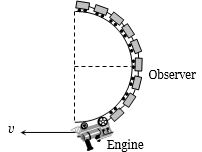
- 6A train has just complicated a $U-$curve in a track which is a semicircle. The engine is at the forward end of the semi circular part of the track while the last carriage is at the rear end of the semicircular track. The driver blows a whistle of frequency $200 Hz.$ Velocity of sound is $340 m/sec$. Then the apparent frequency as observed by a passenger in the middle of a train when the speed of the train is $30 m/sec$ is ... $Hz$View Solution
- 7Two waves of frequencies $20 Hz$ and $30 Hz.$ Travels out from a common point. The phase difference between them after $0.6 sec$ isView Solution
- 8A person is observing two trains one coming towards him and other leaving with the same speed $4\, m/s$. If their whistling frequencies are $240\, Hz$ each, then the number of beats per second heard by the person will be:(if velocity of sound is $320\, m/s$)View Solution
- 9The length of two open organ pipes are $l$ and $(l + \Delta l)$ respectively. Neglecting end correction, the frequency of beats between them will be approximately (Here $v$ is the speed of sound)View Solution
- 10Three waves of equal frequency having amplitudes $10\mu m,$ $4\mu m,$ $7\mu m$ arrive at a given point with successive phase difference of $\frac{\pi }{2},$ the amplitude of the resulting wave in $\mu m$ is given byView Solution