MCQ
Velocity of transverse wave in stretched string doesn't depend on:
  • A
    Density
  • B
    Radius
  • C
    Tension
  • Length

Answer

Correct option: D.
Length
(D)

Need a full question paper?

Generate a complete, print-ready paper with questions like this in minutes — across 16+ boards, with answer keys.

Start Generating Free

Similar questions

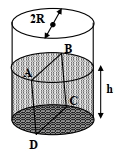
Water is filled up to a height $h$ in a beaker of radius $R$ as shown in the figure. The density of water is $\rho$, the surface tension of water is $T$ and the atmospheric pressure is $P_0$. Consider a vertical section $A B C D$ of the water column through a diameter of the beaker. The force on water on one side of this section by water on the other side of this section has magnitude
From a circle of radius $a,$ an isosceles right angled triangle with the hypotenuse as the diameter of the circle is removed. The distance of the centre of gravity of the remaining position from the centre of the circle is
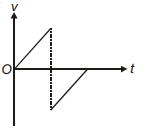
The velocity $(v)$-time $(t)$ graph for a particle moving along $x$-axis is shown in the figure. The corresponding position $(x)$ - time $(t)$ is best represented by
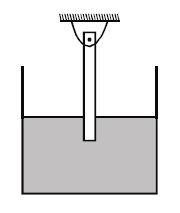
A thin vertical uniform wooden rod is pivoted at the top and immersed in water as shown. The container is slowly raised. At a certain moment, the equilibrium becomes unstable. If density of water is $9/5$ times the density of wood, then ratio of total length of rod to the submerged length of rod, at that moment is
The value of $g $ at a place decreases by $ 2\%.$ The barometric height of mercury
The temperature of an ideal gas is reduced from  $927^\circ C$ to  $27^\circ C$. The $r.m.s.$ velocity of the molecules becomes
The angular speed of a body changes from ${\omega _1}$ to ${\omega _2}$ without applying a torque but due to changes in moment of inertia. The ratio of radii of gyration in two cases is
The two thigh bones (femures), each of cross-sectional area $10 \,cm ^2$ support the upper part of a person of mass $50 \,kg$. The average pressure sustained by the femures is ............. $N / m ^2$
A uniform metallic rod rotates about its perpendicular bisector with constant angular speed. If it is heated uniformly to raise its temperature slightly:
A mass $m$ is placed at point $P$ lies on the axis of a ring of mass $M$ and radius $R$ at a distance $R$ from its centre. The gravitational force on mass $m$ is