Question
Verify Euler's relation for the following: A cube.

Answer

Euler's relation is: $F - E + V = 2$
A cube: (There is an error in this question. It should have been a square prism rather than square.)
Number of faces $= F = 2$ squares + $4$ rectangular $= 6$
 Number of edges $= E = 12$
Number of vertices $= V = 8$
$\Rightarrow (F - E + V) = 6 - 12 + 8 = 2$

Need a full question paper?

Generate a complete, print-ready paper with questions like this in minutes — across 16+ boards, with answer keys.
Start Generating Free

Similar questions

Factorise the expressions and divide them as directed.
(i) $\left(y^2+7 y+10\right)÷(y+5)$
(ii) $\left(m^2-14 m-32\right)÷(m+2)$
(iii) $\left(5 p^2-25 p+20\right)÷(p-1)$
(iv) $4 y z\left(z^2+6 z-16\right)÷2 y(z+8)$
(v) $5 p q\left(p^2-q^2\right)÷2 p(p+q)$
(vi) $12 x y\left(9 x^2-16 y^2\right) ÷ 4 x y(3 x+4 y)$
(vii) $39 y^3\left(50 y^2-98\right)÷26 y^2(5 y+7)$
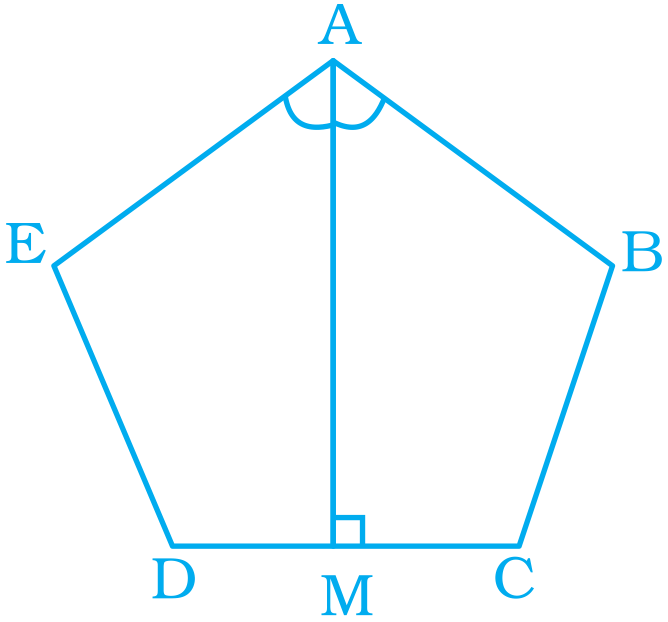
$ABCDE$ is a regular pentagon. The bisector of angle A meets the side $CD$ at $M$. Find $\angle\text{AMC}.$
Surabhi borrowed a sum of $Rs. 12000$ from a finance company to purchase a refrigerator. If the rate of interest is $5\%$ per annum compounded annually, calculate the compound interest that Surabhi has to pay to the company after $3$ years.
Find the product: $ 1.5 x\left(10 x^2 y-100 x y^2\right) $
Roma borrowed Rs. $64000$ from a bank for $1\frac{1}{2}$ years at the rate of $10\%$ per annum. Compute the total compound interest payable by Roma after $1\frac{1}{2}$ years, if the interest is compounded half-yearly.
Which of the two rational numbers is greater in the given pair? $\frac{-1}{2}\ \text{or}\ -1$
Find the product: $\big(−\frac{7}{4}\text{ab}^2\text{c}−\frac{6}{25}\text{a}^2\text{c}^2\big)\big(−50\text{a}^2\text{b}^2\text{c}^2\big)$
A 5 m 60 cm high vertical pole casts a shadow 3 m 20 cm long. Find at the same time
(i) the length of the shadow cast by another pole 10 m 50 cm high.
(ii) the height of a pole which casts a shadow 5 m long.
Verify the property $x \times (y + z) = x \times y + x \times z$ of rational numbers by taking. $\text{x}=\frac{-1}{2},\ \text{y}=\frac{2}{3},\ \text{z}=\frac{3}{4}$
Find the greatest common factor of the polynomial:
$7 x, 21 x^2$ and $14 x y^2$