Question
Verify Rolle's theorem of the following function on the indicated interval
$\text{f}(\text{x})=\frac{6\text{x}}{\pi}-4\sin^{2}\text{x}\text{ on }\Big[0,\frac{\pi}{6}\Big]$
Answer

The given function is $\text{f}(\text{x})=\frac{6\text{x}}{\pi}-4\sin^{2}\text{x}$

Since $\sin\text{x}\ \&\ \text{x}$ are everywhere continuous and differentiable, f(x) is continuous on $\Big[0,\frac{\pi}{6}\Big]$ and differentiable on $\Big(0,\frac{\pi}{6}\Big)$

Also,

$\text{f}\Big(\frac{\pi}{6}\Big)=\text{f}(0)=0$

Thus, f(x) satisfies all the conditions of Rolle's theorem.

Now, we have to show that there must exist a point $\text{c}\in\Big(0,\frac{\pi}{6}\Big)$ such that f'(c) = 0.

We have

$\text{f}(\text{x})=\frac{6\text{x}}{\pi}-4\sin^{2}\text{x}$

$\Rightarrow\text{f}'(\text{x})=\frac{6}{\pi}-8\sin\text{x}\cos\text{x}$

$\therefore\ \text{f}'(\text{x})=0$

$\Rightarrow\frac{6}{\pi}-8\sin\text{x}\cos\text{x}=0$

$\Rightarrow\sin2\text{x}=\frac{3}{2\pi}$

$\Rightarrow\text{x}=\frac{1}{2}\sin^{-1}\Big(\frac{3}{2\pi}\Big)$

Thus, $\text{c}=\frac{1}{2}\sin^{-1}\Big(\frac{3}{2\pi}\Big)\in\Big(0,\frac{\pi}{6}\Big)$ such that f'(c) = 0.

Hence, Rolle's theorem is verified.

Need a full question paper?

Generate a complete, print-ready paper with questions like this in minutes — across 16+ boards, with answer keys.

Start Generating Free

Similar questions

Differentiate the following functions with respect to x:
$\tan^{-1}\Big(\frac{\sqrt{\text{x}}+\sqrt{\text{a}}}{1-\sqrt{\text{xa}}}\Big)$
By Using properties of definite integrals, evaluate the following integral in Exercise:
$\int^{\pi}_{0}\log(1+\cos\text{x})\text{dx}$
Find the point on the curve $\frac{\text{x}^2}{9}+\frac{\text{y}^2}{16}=1$ at which the tangent are:
  1.  parallel to x-axis
  2.  paralle to y- axis
$\text{Evaluate} \lim\limits_{x \rightarrow\frac{\pi}{4}} \bigg( \frac{ \sin x - \cos x}{x- \frac{\pi}{4}} \bigg)$
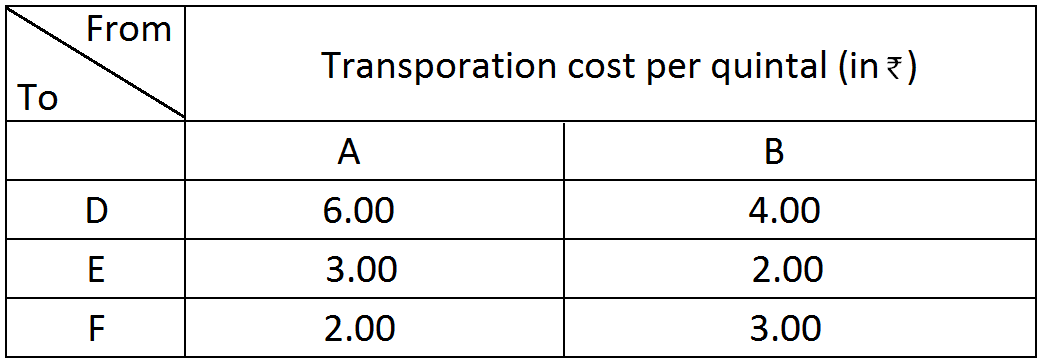
 Tow godowns, A and B, have grain storage capacity of 100 quintals and 50 quintals respectively. They supply to 3 ration shops, D, E and F, whose requirements are 60, 50 and 40 quintals respectively. The cost of transportation per quintal from the godowns to the shops are given in the following table:

How should the supplies be transported in order that the transportation cost is minimum? 

If the marginal cost of maufacturing a certain item is given by $\text{C}(\text{x})=\frac{\text{dC}}{\text{dx}}=2+0.15\text{x}$. Find the total cost function C(x), given that C(0) = 100.
Solve the following systems of linear equations by cramer's rule:
3x + y = 19,
3x - y = 23
Differentiate the following functions with respect to x:
$\cos^{-1}\Big(\frac{1-\text{x}^{2\text{n}}}{1+\text{x}^{2\text{n}}}\Big), <\text{x}<\infty$
Show that the line segments joining the mid-points of opposite sides of a quadrilateral bisects each other.
If $\vec{\text{a}} \times \vec{\text{b}} = \vec{\text{c}} \times \vec{\text{d}}$ and $\vec{\text{a}} \times \vec{\text{c}} = \vec{\text{b}} \times \vec{\text{d}},$ show that $\vec{\text{a}} - \vec{\text{d}}$ is parallel to $\vec{\text{b}} - \vec{\text{c}},$ where $\vec{\text{a}} \neq \vec{\text{d}}$ and $\vec{\text{b}} \neq \vec{\text{c}}.$