Question
Verify that 2 is a zero of the polynomial $x^3 + 4x^2 - 3x - 18.$

Answer

Let $p(x) = x^3 + 4x^2 - 3x - 18$
Now, $p(2) = 2^3 + 4 \times 2^2 - 3 \times 2 - 18 = 0$
$\therefore$ 2 is a zero of p(x)​​​​.

Need a full question paper?

Generate a complete, print-ready paper with questions like this in minutes — across 16+ boards, with answer keys.
Start Generating Free

Similar questions

Find all the zeros of$ (x^4^+ x^3 - 23x^2 - 3x + 60),$ if it is given that two of its zeros are $\sqrt3$ and $-\sqrt3.$
A reservoir in the form of the frustum of a right circular cone contains $44 \times 10^7$ litres of water which fills it completely. The radii of the bottom and top of the reservoir are 50 metres and 100 metres respectively. Find the depth of water and the lateral surface area of the reservoir.
The central angles of two sectors of circles of radii $7\ cm$ and $21\ cm$ are respectively $120^\circ$ and $40^\circ $. Find the areas of the two sectors as well as the lengths of the corresponding arcs. What do you observe?
Water is flowing at the rate of $2.52 km / h$ through a cylindrical pipe into a cylindrical tank, the radius of whose base is 40 cm, if the increase in the level of water in the tank, in half an hour is 3.15 m, find the internal diameter of the pipe.
Show graphically that each of the following given systems of equations has infinitely many solutions:
2x + 3y = 6, 4x + 6y = 12
The three vertices of a parallelogram $A B C D$ are $A(3,-4), B(-1,-3)$ and $C(-6,2)$. Find the coordinates of vertex $D$ and find the area of parallelogram $A B C D$.
Solve the following quadratic equation:
$\frac{3}{\text{x}+1}-\frac{1}{2}=\frac{2}{\text{3x}-1},$ $\text{x}\neq-1,\ \frac{1}{3}$
From a point on the ground 40m away from the foot of a tower, the angle ofclevation of the top of the t wer is 30°. The angle of elevation of the top of a water tank (on the top of the tower) is 45°. Find:
  1. The height of the tower.
  2. The depth of the tank.
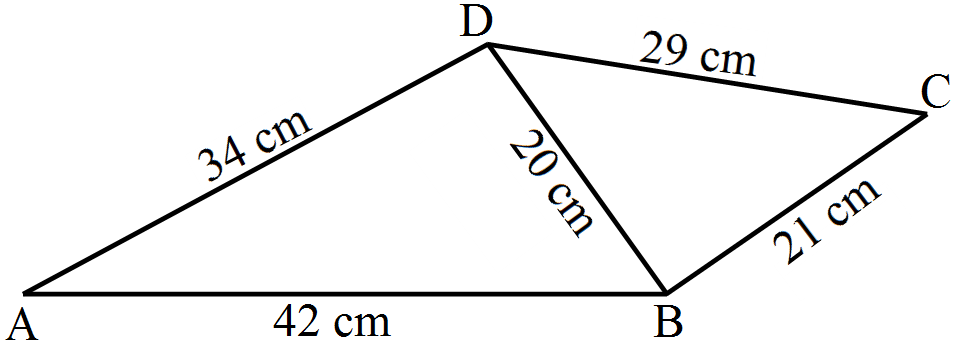
Find the area of the quadrilateral ABCD in which AB = 42cm, BC = 21cm, CD = 29cm, DA = 34cm and diagonal BD = 20cm.
The length of a rectangle is thrice as long as the side of a square. The side of the square is 4cm more than width of a the rectangle. Their areas being equal, find their dimensions.