Question
Verify that the units weber and volt-second are the same.

Answer

$\text{v}=\frac{\text{d}\phi}{\text{dt}}$
$\Rightarrow\text{d}\phi=\text{dt}$
Charge in flux has unit weber and potential difference as volt.

Need a full question paper?

Generate a complete, print-ready paper with questions like this in minutes — across 16+ boards, with answer keys.
Start Generating Free

Similar questions

Answer the following questions: Why must both the objective and the eyepiece of a compound microscope have short focal lengths.
Suppose $\vec{\text{a}}$ is a vector of magnitude 4.5 unit due north. What is the vector:
  1. $3\vec{\text{a}}$
  2. $-4 \ \vec{\text{a}}?$
A closely wound solenoid of 800 turns and area of cross-section $2.5 \times 10^{-4} m^2$ carries a current of 3.0 A. Explain the sense in which the solenoid acts like a bar magnet. What is its associated magnetic moment?
The weather report reads, "Temperature 20°C : Relative humidity 100%". What is the dew point?
A light ray is refracted from medium
$(1)$ to medium
$(2).$ Their refractive indices are $n_1$ and $n_2$, respectively and $n_2 < n_1.$ Write an expression for the critical angle of incidence.
The pressure of a gas changes linearly with volume from $10\ kPa, 200\ cc$ to $50\ kPa, 50\ cc$.
  1. Calculate the work done by the gas.
  2. If no heat is supplied or extracted from the gas, what is the change in the internal energy of the gas?
Discuss sign convention of distance for reflection by spherical mirror and refraction by spherical lens.
Show that the dimensions of the displacement current $\epsilon_0\frac{\text{d}\phi_\text{E}}{\text{dt}}$ are that of an electric current.
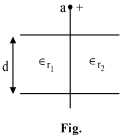
The capacitance of a parallel plate air capacitor is $10 \mu F$. This capacitor is divided into two equal parts as shown in the figure and filled with a medium having dielectric constant $\epsilon_{r_1}=2$ and $\epsilon_{r_2}=4$. Find the value of capacitance of this system.
Image
N small conducting liquid droplets, each of radius r, are charged to a potential V each. These droplets coalesce to form a single large drop without any charge leakage. Find the potential of the large drop.