Question
Very-Short and Short-Answer Questions:
Solve $\frac{3}{\text{x}+\text{y}}+\frac{2}{\text{x}-\text{y}}=2$ and $\frac{9}{\text{x}+\text{y}}-\frac{4}{\text{x}-\text{y}}=1$
Answer

The given system of equations is:
$\frac{3}{\text{x+y}}+\frac{2}{\text{x}-\text{y}}=2\ ....(\text{i})$
$\frac{9}{\text{x+y}}-\frac{4}{\text{x}-\text{y}}=1\ ...(\text{ii})$
Substituting $\frac{1}{\text{x+y}}=\text{u}$ and $\frac{1}{\text{x}-\text{y}}=\text{v}$ in $(i)$ and $(ii),$ the given equations are changed to:
$3v + 2v = 2 ...(iii)$
$9u - 4v = 1 ...(iv)$
Multiplying $(i)$ by $2$ and adding it with $(ii),$ we get
$15\text{u}=4+1$
$\Rightarrow\text{u}=\frac{1}{3}$
Multiplying $(i)$ by $3$ and subtracting $(ii)$ from it, we get
$6\text{v}+4\text{v}=6-1$
$\Rightarrow\text{u}=\frac{5}{10}=\frac{1}{2}$
Therefore,
$x + y = 3 ...(v)$
$x - y = 2 ....(vi)$
Now, adding $(v)$ and $(vi)$ we have
$2\text{x}=5$
$\Rightarrow\text{x}=\frac{5}{2}$
Substituting $\text{x}=\frac{5}{2}$ in $(v),$ we have
$\frac{5}{2}+\text{y}=3$
$\Rightarrow\text{y}=3-\frac{5}{2}=\frac{1}{2}$
Hence, $\text{x}=\frac{5}{2}$ and $\text{y}=\frac{1}{2}.$

Need a full question paper?

Generate a complete, print-ready paper with questions like this in minutes — across 16+ boards, with answer keys.

Start Generating Free

Similar questions

Show that the points $A (1, 7), B (4, 2), C (-1, -1)$ and $D (-4, 4)$ are the vertices of a square.
A toy is in the form of a cone mounted on a hemisphere with the same radius. The diameter of the base of the conical portion is $6\ cm$ and its height is $4\ cm.$ Determine the surface area of the toy. $(\text{Use}\ \pi=3.14)$
Prove the following trigonometric identities.
$\frac{\tan\text{A}}{(1+\tan^2\text{A})^2}+\frac{\cot\text{A}}{(1+\cot^2\text{A})}=\sin\text{A}\cos\text{A}$
If the roots of the equation $\left(c^2-a b\right) x^2-2\left(a^2-b c\right) x+\left(b^2-a c\right)=0$ are real and equal, show that either $a = 0$ or $(a^3+ b^3+ c^3) = 3abc.$
If $\sin\text{A}=\frac{9}{41},$ computer $\cos A$ and $\tan A.$
Write the first five terms of the following sequences whose $n^{th}$ terms are:
$\text{a}_\text{n}=\frac{\text{n}-3}{3}$
Prove the following identities:
$\frac{\cos\theta}{(1-\tan\theta)}+\frac{\sin^2\theta}{(\cos\theta-\sin\theta)}=(\cos\theta+\sin\theta)$
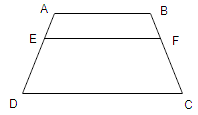
$ABCD$ is a trapezium with $AB || DC. E$ and $F$ are two points on non-parallel sides $AD$ and $BC$ respectively, such that $EF$ is parallel to $AB$. Show that $\frac{AE}{ED}=\frac{BF}{FC}$ 
Find the roots of the following equations, if they exist, by applying the quadratic formula:
$2 x^2+x-4=0$
A point $P$ divides the line segment joining the points $A(3, -5)$ and $B(-4, 8)$ such that $\frac{\text{AP}}{\text{PB}}=\frac{\text{k}}{1}.$ If $P$ lies on the line $x + y = 0,$ then find the value of $k.$