MCQ
Vibration magnetometer is used for comparing
  • A
    Magnetic fields
  • B
    Earth's field
  • C
    Magnetic moments
  • All of the above

Answer

Correct option: D.
All of the above
d
Vibration magnetometer is used for comparison of magnetic moments and magnetic fields. This device works on the principle, that whenever a freely suspended magnet in a uniform magnetic field, is disturbed from it's equilibrium position, it starts vibrating about the mean position.

Need a full question paper?

Generate a complete, print-ready paper with questions like this in minutes — across 16+ boards, with answer keys.

Start Generating Free

Similar questions

$A$ cone of radius $r$ and height $h$ rests on a rough horizontal surface, the coefficient of friction between the cone and the surface being $\mu$ . $A$ gradually increasing horizontal force $F$ is applied to the vertex of the cone. The largest value of $\mu$ for which the cone will slide before it topples is
A light inextensible string that goes over a smooth fixed pulley as shown in the figure connects two blocks of masses $0.36 \mathrm{~kg}$ and $0.72 \mathrm{~kg}$. Taking $g=10 \mathrm{~m} / \mathrm{s}^2$, find the work done (in joules) by the string on the block of mass $0.36 \mathrm{~kg}$ during the first second after the system is released from rest.
If transmission power of a surface is $\frac{1}{9}$, reflective power is $\frac{1}{6}$, then what is its absorptive power?
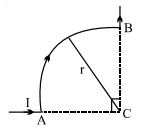
A wire carrying $I$ is shaped as shown. Section $AB$ is a quarter circle of radius $r.$ The magnetic field at $C$ is directed
$A$ long straight wire is placed along the axis of a circular ring of radius $R$. The mutual inductance of this system is
A mass $'m'$ moves with a velocity $'v'$ and collides inelastically with another identical mass in rest. After collision the $I^{st}$ mass moves with velocity $\frac{v}{{\sqrt 3 }}$ in a direction perpendicular to the initial direction of motion. Find the speed of the $2^{nd}$ mass after collision
A body starts from rest. What is the ratio of the distance travelled by the body during the $4^{th}$ and $3^{rd}$ second
A particle of mass $m $ is moving in a horizontal circle of radius $r$  under a centripetal force equal to $ - K/{r^2}$, where $K$  is a constant. The total energy of the particle is
$A$ curren of $2\,A$ is increasing at $a$ rate of $4\, A/s$ through a coil of inductance $2\,H$. The energy stored in the inductor per unit time is....$J/s$
A radioactive sample with a half life of $1$ month has the label : “Activity$=2\, micro\,\,curies$ on $1-8-1991$.'' What will be its activity two months earlier ............ $micro\,\, curies$.