MCQ
Visible light passing through a circular hole forms a diffraction disc of radius 0.1mm on a screen. If an X-ray is passed through the same setup, the radius of the diffraction disc will be:
  • A
    zero
  • < 0.1mm
  • C
    0.1mm
  • D
    > 0.1m

Answer

Correct option: B.
< 0.1mm
Radius of the diffraction disc is directly proportional to the wavelength of the light used for the given hole. We know that the wavelength of an X-ray is less than the wavelength of visible light. If an X-ray is passed through the same setup, the radius of the diffraction disc will be less than 0.1m.

Need a full question paper?

Generate a complete, print-ready paper with questions like this in minutes — across 16+ boards, with answer keys.
Start Generating Free

Similar questions

Mass per unit area of a circular disc of radius $\mathrm{a}$ depends on the distance $\mathrm{r}$ from its centre as $\sigma(\mathrm{r})=\mathrm{A}+\mathrm{Br} .$ The moment of inertia of the disc about the the axis, perpendicular to the plane and passing through its centre is
A standing wave having $3$ nodes and $2$ antinodes is formed between two atoms having a distance $1.21\;\mathring A$ between them. The wavelength of the standing wave is .... $\mathop A\limits^o $
Two moles of ideal helium gas are in a rubber balloon at $30^{\circ} C$. The balloon is fully expandable and can be assumed to require no energy in its expansion. The temperature of the gas in the balloon is slowly changed to $35^{\circ} C$. The amount of heat required in raising the temperature is nearly (take $R =8.31 J / mol$. $K$)
The equation of motion of a projectile is $y = Ax -Bx^2$ where $A$ and $B$ are the constants of motion. The horizontal range of the projectile is
If $m$ is the mass, $\theta$ is temperature and $'a\ '$ is specific heat, then thermal capacity $K$ is given by:
For a particle showing motion under the force $F=-5(x-2)$, the motion is ...........
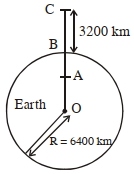
In the reported figure of earth, the value of acceleration due to gravity is same at point $A$ and $C$ but it is smaller than that of its value at point $B$ (surface of the earth). The value of OA $: AB$ will be $x : y .$ The value of $x$ is $\ldots \ldots \ldots$
Which of the following pairs of physical quantities may be represented in the same unit?
The intensity of a progressing plane wave in loss-free medium is
The angular velocity and the amplitude of a simple pendulum is $\omega $ and $a$ respectively. At a displacement $X$ from the mean position if its kinetic energy is $T$ and potential energy is $V$, then the ratio of $T$ to $V$ is