MCQ
Visible light passing through a circular hole forms a diffraction disc of radius $0.1\ mm$ on a screen. If an $X-$ray is passed through the same setup, the radius of the diffraction disc will be:
- Azero
- ✓$< 0.1\ mm$
- C$0.1\ mm$
- D$> 0.1m$
Radius of the diffraction disc is directly proportional to the wavelength of the light used for the given hole. We know that the wavelength of an $X-$ray is less than the wavelength of visible light. If an $X-$ray is passed through the same setup, the radius of the diffraction disc will be less than $0.1m.$
Generate a complete, print-ready paper with questions like this in minutes — across 16+ boards, with answer keys.
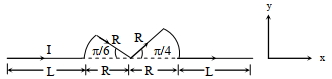
$(A)$ If $\vec{B}$ is along $\hat{z}, F \propto(L+R)$
$(B)$ If $\overrightarrow{ B }$ is along $\hat{ x }, F =0$
$(C)$ If $\vec{B}$ is along $\hat{y}, F \propto(L+R)$
$(D)$ If $\overrightarrow{ B }$ is along $\hat{ z }, F =0$