MCQ
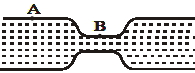
Water flows in a horizontal tube (see figure). The pressure of water changes by $700\; \mathrm{Nm}^{-2}$ between $\mathrm{A}$ and $\mathrm{B}$ where the area of cross section are $40\; \mathrm{cm}^{2}$ and $20\; \mathrm{cm}^{2},$ respectively. Find the rate of flow of water through the tube. ........ $\mathrm{cm}^{3} / \mathrm{s}$

(density of water $=1000\; \mathrm{kgm}^{-3}$ )
  • A
    $1810$
  • B
    $3020 $
  • $2720 $
  • D
    $2420$

Answer

Correct option: C.
$2720 $
c
Rate of flow of water $=\mathrm{A}_{\mathrm{A}} \mathrm{V}_{\mathrm{A}}=\mathrm{A}_{\mathrm{B}} \mathrm{V}_{\mathrm{B}}$

$(40) \mathrm{V}_{\mathrm{A}}=(20) \mathrm{V}_{\mathrm{B}}$

$\mathrm{V}_{\mathrm{B}}=2 \mathrm{V}_{\mathrm{A}}$

Using Bernoulli's theorem

$\mathrm{P}_{\mathrm{A}}+\frac{1}{2} \rho \mathrm{V}_{\mathrm{A}}^{2}=\mathrm{P}_{\mathrm{B}}+\frac{1}{2} \rho \mathrm{V}_{\mathrm{B}}^{2}$

$\mathrm{P}_{\mathrm{A}}-\mathrm{P}_{\mathrm{B}}=\frac{1}{2} \rho\left(\mathrm{V}_{\mathrm{B}}^{2}-\mathrm{V}_{\mathrm{A}}^{2}\right)$

$700=\frac{1}{2} \times 1000\left(4 \mathrm{V}_{\mathrm{A}}^{2}-\mathrm{V}_{\mathrm{A}}^{2}\right)$

$\mathrm{V}_{\mathrm{A}}=0.68 \mathrm{m} / \mathrm{s}=68 \mathrm{cm} / \mathrm{s}$

Rate of flow $=\mathrm{A}_{\mathrm{A}} \mathrm{V}_{\mathrm{A}}$

$=(40)(68)=2720\; \mathrm{cm}^{3} / \mathrm{s}$

Need a full question paper?

Generate a complete, print-ready paper with questions like this in minutes — across 16+ boards, with answer keys.

Start Generating Free

Similar questions

A particle moves along a circle of radius $\left( {\frac{{20}}{\pi }} \right)\,m$ with constant tangential acceleration. If the velocity of the particle is $80 \,m/s$ at the end of the second revolution after motion has begin, the tangential acceleration is
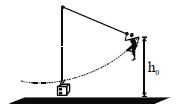
Starting from rest on her swing at initial height $h_0$ above the ground, Saina swings forward. At the lowest point of her motion, she grabs her bag that lies on the ground. Saina continues swinging forward to reach maximum height $h_1$ . She then swings backward and when reaching the lowest point of motion again, she simple lets go off the bag, which falls freely. Saina's backward swing then reaches maximum height $h_2$ . Neglecting air resistance, how are the three heights related?
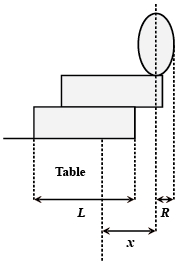
Two identical uniform rectangular blocks (with longest side $L$ ) and a solid sphere of radius $R$ are to be balanced at the edge of a heavy table such that the centre of the sphere remains at the maximum possible horizontal distance from the vertical edge of the table without toppling as indicated in the figure. If the mass of each block is $M$ and of the sphere is $M / 2$, then the maximum distance $x$ that can be achieved is
The displacement of a particle moving in a straight line depends on time as $x=\alpha t^3+\beta t^2+\gamma t+\delta$.The ratio of initial acceleration to its initial velocity depends
A simple harmonic oscillator of angular frequency $2\,rad\,s^{-1}$ is acted upon by an external force $F = sin\,t\,N .$ If the oscillator is at rest in its equilibrium position at $t = 0,$ its position at later times is proportional to
One mole of an ideal monatomic gas undergoes a process described by the equation $PV^3 =$ constant. The heat capacity of the gas during this process is 
A vertical mass spring system executes simple harmonic oscillations with a period of $2\,s$. A quantity of this system which exhibits simple harmonic variation with a period  of $1\, sec$ is
A wave equation which gives the displacement along the $Y$ direction is given by the equation $y = {10^4}\sin (60t + 2x)$, where $x$ and $y$ are in metres and $t$ is time in seconds. This represents a wave
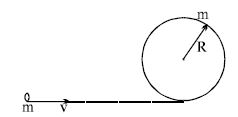
A circular hoop of mass $m$ and radius $R$ rests flat on a horizontal frictionless surface. A bullet, also of mass $m$ and moving with a velocity $v$ , strikes the hoop and gets embedded in it. The thickness of the hoop is much smaller than $R$ . The angular velocity with which the system rotates after the bullet strikes the hoop is 
Steam at $100^o C$ is added slowly to $1400 \,\,gm$ of water at $16^o C$ until the temperature of water is raised to $80^o C$. The mass of steam required to do this is ($L_V =$  $540\,\,cal/gm$) ........... $gm$