MCQ
Water flows steadily through a horizontal pipe of variable cross-section. If the pressure of water is $P$ at a point where flow speed is $v$ , the pressure at another point where the flow speed is $2v$ , is (Take density of water as $\rho $ )
  • $P - \frac{{3\rho {v^2}}}{2}$
  • B
    $P - \frac{{\rho {v^2}}}{2}$
  • C
    $P - \frac{{3\rho {v^2}}}{4}$
  • D
    $P -\rho v^2$

Answer

Correct option: A.
$P - \frac{{3\rho {v^2}}}{2}$
a
Applying Bernoullis's Equation at two points$:$

$p_{1}+\frac{\rho v_{1}^{2}}{2}=p_{2}+\frac{\rho v_{2}^{2}}{2}$

Given, $p_{1}=p, \quad v_{1}=v \quad v_{2}=2 v$

$p_{2}=p+\frac{\rho v^{2}}{2}-\frac{4 \rho v^{2}}{2}$

$p_{2}=p-\frac{3 \rho v^{2}}{2}$

Need a full question paper?

Generate a complete, print-ready paper with questions like this in minutes — across 16+ boards, with answer keys.

Start Generating Free

Similar questions

The resistance of a galvanometer is $50\, ohm$ and the maximum current which can be passed through it is $0.002\, A$. What resistance must be connected to it in order to convert it into an ammeter of range $0 -0.5\, A$ ?....$ohm$
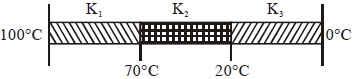
Three rods of identical cross-section and lengths are made of three different materials of thermal conductivity $K _{1}, K _{2},$ and $K _{3}$, respectively. They are joined together at their ends to make a long rod (see figure). One end of the long rod is maintained at $100^{\circ} C$ and the ther at $0^{\circ} C$ (see figure). If the joints of the rod are at  $70^{\circ} C$ and $20^{\circ} C$ in steady state and there is no loss of energy from the surface of the rod, the correct relationship between $K _{1}, K _{2}$ and $K _{3}$ is 
In Young's double slit experiment, the phase difference between the light waves reaching third bright fringe from the central fringe will be ($\lambda$ $=6000 Å$ )
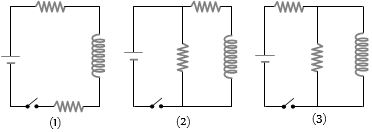
The figure shows three circuits with identical batteries, inductors, and resistors. Rank the circuits according to the current through the battery $(i)$ just after the switch is closed and $(ii)$ a long time later, greatest first
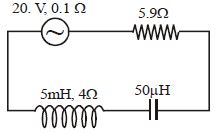
In the circuit of fig, the source frequency is $\omega  = 2000\,rad/s$. The current in the circuit will be....$A$
A ball of mass $ m$  moving with velocity $V$, makes a head on elastic collision with a ball of the same mass moving with velocity $2V$ towards it. Taking direction of $V$ as positive velocities of the two balls after collision are
The current voltage relation of diode is given by $I=(e^{1000V/T} -1)\;mA$, where the applied voltage $V$ is in volts and the temperature $T$ is in degree Kelvin. If a student makes an error measuring $ \mp 0.01\;V$ while measuring the current of $5\; mA$ at $300\; K$, what will be the error in the value of current in $mA$ ?
$A$ source $S$ of frequency $f_0$ and an observer $O$, moving with speeds $v_1$ and $v_2$ respectively, are movinng away from each other. When they are separated by distance a $(t =0)$, a pulse is emitted by the source. This pulse is received by $O$ at time $t_1$ then $t_1$, is equal to
Two springs $A$ and $B$ having spring constant $K_{A}$ and $K_{B}\left(K_{A}=2 K_{B}\right)$ are stretched by applying force of equal magnitude. If energy stored in spring $A$ is $E_{A}$ then energy stored in $B$ will be
When the convergent nature of a convex lens will be less as compared with air