Question
Water flows through a horizontal tube as shown in If the difference of heights of water column in the vertical tubes is 2cm, and the areas of cross-section at A and B are $4cm^2$ and $2cm^2$ respectively, find the rate of flow of water across any section.
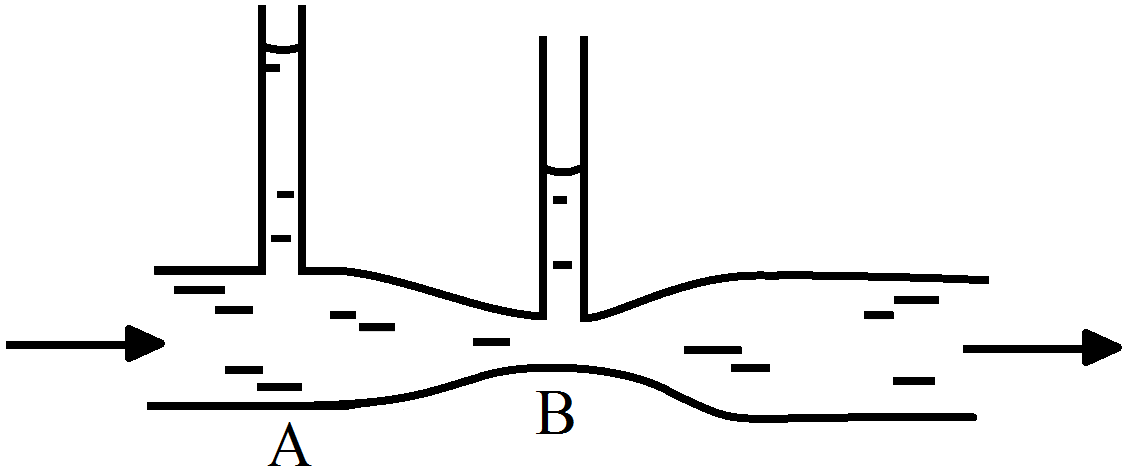
Answer

The height difference $=2\text{cm}=0.02\text{m}$

The difference of pressure between A and B $=\text{p}_\text{a}-\text{p}_\beta=\rho\text{gh}$

$=\frac{1}{2}\rho \text{Va}^2=\text{p}_\beta+\frac{1}{2}\rho \text{V}\beta^2$

$=1000\times10\times0.02=200\text{N}/\text{m}^2$

Let the rate of flow of water be Qcc/s i.e. $=\text{Q}\times10^{-6}\text{m}^3/\text{s}$

Area of the cross-section at $\text{A}=4\text{cm}^2=\frac{4}{10000}\text{m}^2$

The speed at $\text{A}=\text{v}_\text{a}=\frac{\text{Q}\times10^{-6}}{\Big(\frac{4}{10000}\Big )}\text{m}/\text{s}=\frac{\text{Q}}{400}\text{m}/\text{s}$

Area of the cross-section at $\text{B}=2\text{cm}^2=\frac{2}{10000}\text{m}^2$

The speed at $\text{B}=\text{v}_\beta=\frac{\text{Q}\times10^{-6}}{\Big(\frac{2}{10000}\Big)}\text{m}/\text{s}=\frac{\text{Q}}{200}\text{m}/\text{s}$

Since the height of both the points are the same, from Bernoulli's theorem,

$\text{p}_\text{a}+\frac{1}{2}\rho\text{V}\text{a}^2=\text{p}\beta+\frac{1}{2}\rho\text{V}\beta^2$

$\Rightarrow\text{p}_\text{a}-\text{p}_\beta=\frac{1}{2}\rho\big(\text{V}\beta^2-\text{V}\text{a}^2\big)$

$=\frac{1}{2}\times1000\times\text{Q}^2\Big\{\Big(\frac{1}{2000}\Big)^2-\Big(\frac{1}{400}\Big)^2\Big\}$

$\Rightarrow\text{p}_\text{a}-\text{p}_\beta=\Big(\frac{1}{20}\Big)\times\text{Q}^2\Big\{\frac{1}{4}-\frac{1}{16}\Big\}=\frac{3\text{q}^2}{320}$

$\Rightarrow200=\frac{3\text{Q}^2}{320}$

$\Rightarrow\text{Q}^2=200\times\frac{320}{3}=21333$

$\Rightarrow\text{Q}=146\text{cc}/\text{s}$

Need a full question paper?

Generate a complete, print-ready paper with questions like this in minutes — across 16+ boards, with answer keys.

Start Generating Free

Similar questions

In a head-on collision between two particles, is it necessary that the particles will acquire a common velocity at least for one instant?
Sketch the magnetic field lines for a current-carrying circular loop near its centre. Replace the loop by an equivalent magnetic dipole and sketch the magnetic field lines near the centre of the dipole. Identify the difference.
In a resonance column experiment, a tuning fork of frequency $400Hz$ is used. The first resonance is observed when the air column has a length of $20.0\ cm$ and the second resonance is observed when the air column has a length of $62.0\ cm$.
  1. Find the speed of sound in air.
  2. How much distance above the open end does the pressure node form? ​​​​​​
A $100pF$ capacitor is charged to a potential difference of $24V$. It is connected to an uncharged capacitor of capacitance $20pF$. What will be the new potential difference across the $100pF$ capacitor?
A wheel is making revolutions about its axis with uniform angular acceleration. Starting from rest, it reaches 100rev/sec in 4 seconds. Find the angular acceleration. Find the angle rotated during these four seconds.
What is the distance travelled by a point during the time, if it moves in x - y plane, according to the relation $\text{x}=\text{a}\sin\omega\text{t}$ and $\text{y}=\text{a}(1-\cos\omega\text{t})?$
A body has a sense of weightlessness in a satellite revolving around the earth, why?
A metal block of area $0.10 m ^2$ is connected to a $0.010 kg$ mass via a string that passes over an ideal pulley $($considered massless and frictionless), as in Fig. $9.13$. A liquid with a film thickness of $0.30 mm$ is placed between the block and the table. When released the block moves to the right with a constant speed of $0.085 m s ^{-1}$. Find the coefficient of viscosity of the liquid.
Mention some areas in which Physics has contributed to development.
The peak power consumed by a resistive coil, when connected to an AC source, is 80W. Find the energy consumed by the coil in 100 seconds, which is many times larger than the time period of the source.