MCQ
Water gas is
  • A
    $CO + C{O_2}$
  • B
    $CO + {N_2}$
  • $CO + {H_2}$
  • D
    $CO + {N_2} + {H_2}$

Answer

Correct option: C.
$CO + {H_2}$
c
The mixture of carbon monoxide $( CO )$ and hydrogen $\left( H _2\right)$ is called water gas.

Syn gas is a mixture of $CO , CO _2$ and $H _2$.

Producer gas is a mixture of flammable gases (principally carbon monoxide and hydrogen) and nonflammable gases (mainly nitrogen and carbon dioxide).

Semi-water gas is a mixture of water gas and producer gas made by passing a mixture of air and steam through heated coke.

Need a full question paper?

Generate a complete, print-ready paper with questions like this in minutes — across 16+ boards, with answer keys.
Start Generating Free

Similar questions

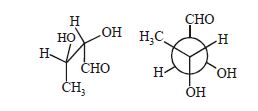
What is the relation between given compounds
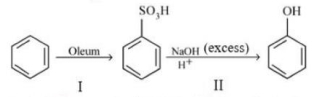
In the following reaction

The $\%$ yield for reaction $I$ is $60 \%$ and that of reaction II is $50 \%$. The overall yield of the complete reaction is $..........\%$ [nearest integer]
Which of the following electronic configuration would be associated with the highest magnetic moment?
Among the following least and most metallic element will be respectively :
$(I)$ $[He]\, 2s^1$           $(II)$ $[Kr]\,5s^2\,4d^{10}\,5p^5$
$(III)$ $[Xe]\,6s^1$          $(IV)$ $[He]\,2s^2\,2p^5$
$2.5\, g$ of protein containing only glycine $\left( C _{2} H _{5} NO _{2}\right)$ is dissolved in water to make $500 \,mL$ of solution. The osmotic pressure of this solution at $300\, K$ is found to be $5.03 \times 10^{-3}$ $bar.$ The total number of glycine units present in the protein is $....$

(Given : $R =0.083\, L\, bar \,K ^{-1} \,mol ^{-1}$ )
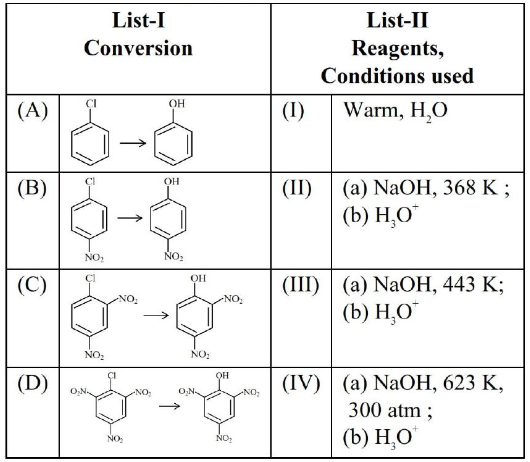
Match List-I with List-II
Image
Choose the correct answer from the options given below :
Given below are two statements :
Statement I : Gallium is used in the manufacturing of thermometers.
Statement II : A thermometer containing gallium is useful for measuring the freezing point (256 K) of brine solution.
In the light of the above statement, choose the correct answer from the options given below:
Which one of the following is an inner orbital complex as well as diamagnetic in behaviour (Atomic number : $Zn = 30$, $Cr = 24$, $Co = 27$, $Ni = 28$)
The $PC{l_5}$ molecule is a result of the hybridisation of
Due to the presence of ambidentate ligands coordination compounds show isomerism. Palladium complexes of the type $[Pd(C_6H_5)_2(SCN)_2]$ and $[Pd(C_6H_5), (NCS)_2]$ are