MCQ
Water has maximum density at
  • A
    $0°C$
  • B
    $32°F$
  • C
    $-4°C$
  • $4°C$

Answer

Correct option: D.
$4°C$
d
(d) Water has maximum density at $4°C.$

Need a full question paper?

Generate a complete, print-ready paper with questions like this in minutes — across 16+ boards, with answer keys.
Start Generating Free

Similar questions

For a particle of a rotating rigid body, $\text{v}=\text{r}\omega,\text{So}$
What is the velocity of a metallic ball of radius r falling in a tank of liquid at the instant when its acceleration is one half that of a freely falling body? (The densities of metal and of liquid are $\rho$ and $\sigma$ respectively and of viscosity of liquid is $\eta$)
One mole of ${O_2}$ gas having a volume equal to $22.4$ litres at ${0^o}C$ and $1$ atmospheric pressure in compressed isothermally so that its volume reduces to $11.2$ litres. The work done in this process is ...... $J$
The distance between two consecutive crests in a wave train produced in a string is $5 cm.$ If $2$ complete waves pass through any point per second, the velocity of the wave is  ..... $cm/sec$
The time period of a particle in simple harmonic motion is equal to the smallest time between the particle acquiring a particular velocity $\overrightarrow{\text{v}}.$ The value of v is
  1. vmax.
  2. 0
  3. between 0 and vmax.
  4. between 0 and - vmax
A bullet moving with a speed of $100$ $m{s^{ - 1}}$can just penetrate two planks of equal thickness. Then the number of such planks penetrated by the same bullet when the speed is doubled will be
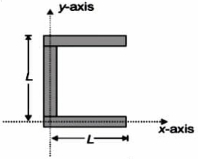
Locate the centre of mass of arrangement shown in figure. The three rods are identical in mass and length
Which of the following laws of explained by the kinetic equation?
If $Q , E$ and $W$ denote respectively the heat added, change in internal energy and the work done by a closed cycle process, then
Four smooth steel balls of equal mass at rest are free to move along a straight line without friction. The first ball is given a velocity of $0.4 \,m/s$. It collides head on with the second elastically, the second one similarly with the third and so on. The velocity of the last ball is .......... $m/s$