Question
Watt-hour meter measures(a) Electric energy(b) Current(c) Voltage(d) Power
       

Answer

(a) Electric energy

Need a full question paper?

Generate a complete, print-ready paper with questions like this in minutes — across 16+ boards, with answer keys.
Start Generating Free

Similar questions

A glass hemisphere of radius 0.04 m and R.I. of the material 1.6 is placed centrally over a cross mark on a paper (i) with the flat face; (ii) with the curved face in contact with the paper. In each case the cross mark is viewed directly from above. The position of the images will be(a) (i) 0.04 m from the flat face; (ii) 0.025 m from the flat face(b) (i) At the same position of the cross mark; (ii) 0.025 m below the flat face(c) (i) 0.025 m from the flat face; (ii) 0.04 m from the flat face(d) For both (i) and (ii) 0.025 m from the highest point of the hemisphere


Dimension of Planck's constant is :
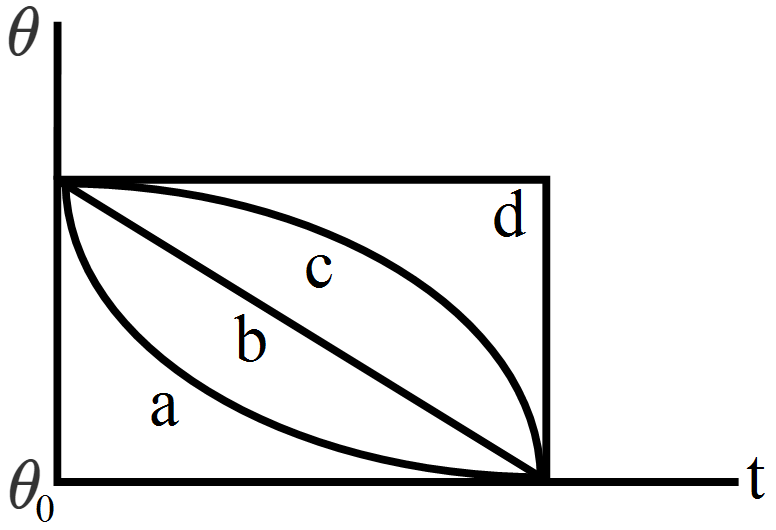
A hot liquid is kept in a big room. Its temperature is plotted as a function of time. Which of the following curves may represent the plot?
A particle is projected in a plane perpendicular to a uniform magnetic field. The area bounded by the path described by the particle is proportional to:
  1. The velocity.
  2. The momentum.
  3. The kinetic energy.
  4. None of these.
A solenoid is at potential difference 60 V and current flows through it is 15 ampere, then the resistance of coil will be (a) 4 Ω (b) 8 Ω(c) 0.25 Ω(d) 2 Ω
       
Which of the following is the radio-isotope? 
$^{39}_{19}{\text{K}}$​, $^{40}_{19}{\text{K}}$
If the current is doubled, the deflection is also doubled in(a) A tangent galvanometer(b) A moving coil galvanometer(c) Both (a) and (b)(d) None of these
   
   
A plano-convex lens of refractive index 1.5 and radius of curvature 30 cm is silvered at the curved surface. Now this lens has been used to form the image of an object. At what distance from this lens an object be placed in order to have a real image of the size of the object(a) 20 cm(b) 30 cm(c) 60 cm(d) 80 cm
       
Which one of the following is similar between electrostatic force and gravitational force?
Focal length of a converging lens in air is R. If it is dipped in water of refractive index 1.33, then its focal length will be around (Refractive index of lens material is 1.5)(a) R(b) 2R(c) 4R(d) R / 2