MCQ
Wave front means:
- AAll particles in it have same phase.
- BFew particles are in same phase, rest are in opposite phase.
- CAll particles have opposite phase of vibrations.
- DAll particles have random vibrations.
Explanation:
It is the imaginary surface representing corresponding points pf a wave that vibrate in unison. When identical waves having a common origin travel through a homogeneous medium, the corresponding crests and troughs at any instant phase.
Generate a complete, print-ready paper with questions like this in minutes — across 16+ boards, with answer keys.
An electron moving with the speed 5  per sec is shooted parallel to the electric field of intensity 1
  . Field is responsible for the retardation of motion of electron. Now evaluate the distance travelled by the electron before coming to rest for an instant (mass of e = 9
  . charge = 1.6
  )
)
|
(a) 7 m |
(b) 0.7 mm |
(c) 7 cm |
(d) 0.7 cm |
A silicon speciman is made into a P-type semi-conductor by dopping, on an average, one Indium atom per 5  silicon atoms. If the number density of atoms in the silicon specimen is 5
  then the number of acceptor atoms in silicon per cubic centimetre will be
|
(a) 2.5 |
(b) 1.0 |
|
(c) 1.0 |
(d) 2.5 |
A plane mirror reflects a pencil of light to form a real image. Then the pencil of light incident on the mirror is
| (a) Parallel | (b) Convergent | (c) Divergent | (d) None of the above |
The potential energy of a particle of mass m is given by
U(x) = 
l1 and l2 are the de-Broglie wavelengths of the particle, when 0 £ x £ 1 and x > 1 respectively. If the total energy of particle is 2E0, the ratio  will be
|
(a) 2 |
(b) 1 |
(c) |
(d) |
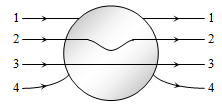
A metallic solid sphere is placed in a uniform electric field. The lines of force follow the path(s) shown in figure as
|
(a) 1 |
(b) 2 |
(c) 3 |
(d) 4 |
If aperture of lens is halved then image will be
|
(a) No effect on size |
(b) Intensity of image decreases |
|
(c) Both (a) and (b) |
(d) None of these |
The approximate ratio of resistances in the forward and reverse bias of the PN-junction diode is
(a) 
|
(b) 
|
(c) 
|
(d) 
|





