MCQ
Wavelength associated with electron motion
- AIncreases with increase in speed of electron
- BRemains same irrespective of speed of electron
- ✓Decreases with increase in speed of ${e^ - }$
- DIs zero
Generate a complete, print-ready paper with questions like this in minutes — across 16+ boards, with answer keys.
(Assume $100\%$ ionization)
$A.$ $0.500\,M\,C _2 H _5 OH ( aq )$ and $0.25\, M\, KBr ( aq )$
$B.$ $0.100\,M\,K _4\left[ Fe ( CN )_6\right]$ (aq) and $0.100\, M$ $FeSO _4\left( NH _4\right)_2 SO _4$ (aq)
$C.$ $0.05 \,M\, K _4\left[ Fe ( CN )_6\right]( aq )$ and $0.25\, M\, NaCl$ (aq)
$D.$ $0.15\, M\, NaCl ( aq )$ and $0.1\, M BaCl _2$ (aq)
$E.$ $0.02\, M\, KCl\, MgCl _{2 .} 6 H _2 O ( aq )$ and $0.05\, M$ $KCl ( aq )$
The number of following statements which is/are correct about phenolphthalein is $.....$.
$A$. It can be used as an indicator for the titration of weak acid with weak base.
$B$. It begins to change colour at $pH =8.4$
$C$. It is a weak organic base
$D$. It is colourless in acidic medium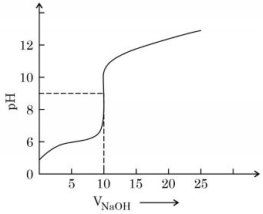
${\left[\mathrm{V}\left(\mathrm{H}_2 \mathrm{O}\right)_6\right]^{3+}, \quad\left[\mathrm{Cr}\left(\mathrm{H}_2 \mathrm{O}\right)_6\right]^{2+}, \quad\left[\mathrm{Fe}\left(\mathrm{H}_2 \mathrm{O}\right)_6\right]^{3+},}$
${\left[\mathrm{Ni}\left(\mathrm{H}_2 \mathrm{O}\right)_6\right]^{3+},\left[\mathrm{Cu}\left(\mathrm{H}_2 \mathrm{O}\right)_6\right]^{2+}}$
[Given atomic numbers: $\mathrm{V}=23, \mathrm{Cr}=24, \mathrm{Fe}=26$,
$\mathrm{Ni}=28, \mathrm{Cu}=29]$