We consider the radiation emitted by the human body. Which of the following statements is true
AIPMT 2003, Easy


Download our appand get started for free
Experience the future of education. Simply download our apps or reach out to us for more information. Let's shape the future of learning together!No signup needed.*
Similar Questions
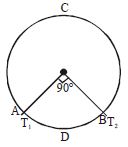
- 1For the figure shown, when arc $ACD$ and $ADB$ are made of same material, the heat carried between $A$ and $B$ is $H$ . If $ADB$ is replaced with another material, the heat carried becomes $2H$ . If the temperatures at $A$ and $B$ are fixed at $T_1$ and $T_2$ , what is the ratio of the new conductivity to the old one of $ADB$View Solution
- 2A cylindrical metallic rod in thermal contact with two reservoirs of heat at its two ends conducts an amount of heat $Q$ in time $t$. The metallic rod is melted and the material is formed into a rod of half the radius of the original rod. What is the amount of heat conducted by the new rod, when placed in thermal contact with the two reservoirs in time $t$ ?View Solution
- 3View SolutionOn a cold morning, a metal surface will feel colder to touch than a wooden surface because
- 4View SolutionAir is bad conductor of heat or partly conducts heat, still vacuum is to be placed between the walls of the thermos flask because
- 5A body of area $1\, cm^2$ is heated to a temperature $1000\, K$. The amount of energy radiated by the body in $1\, second$ is .......... $Joule$ (Stefan's constant $\sigma = 5.67 \times 10^{-8}\, W\, m^{-2}K^{-4}$)View Solution
- 6A cylinder of radius $R$ is surrounded by a cylindrical shell of inner radius $R$ and outer radius $2R$. The thermal conductivity of the material of the inner cylinder is $K_1$ and that of the outer cylinder is $K_2$. Assuming no loss of heat, the effective thermal conductivity of the system for heat flowing along the length of the cylinder isView Solution
- 7The wall with a cavity consists of two layers of brick separated by a layer of air.All three layers have the same thickness and the thermal conductivity of the brick is much greater than that of air. The left layer is at a higher temperature than the right layer and steady state condition exists. Which of the following graphs predicts correctly the variation of temperature $T$ with distance $d$ inside the cavity?View Solution
- 8A room is maintained at ${20^o}C$ by a heater of resistance $20$ ohm connected to $200$ volt mains. The temperature is uniform through out the room and heat is transmitted through a glass window of area $1{m^2}$ and thickness $0.2$ cm. What will be the temperature outside ....... $^oC$ ? Given that thermal conductivity $K=0.2$ for glass is and $J = 4.2 J/cal$View Solution
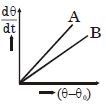
- 9Two circular discs $A$ and $B$ with equal radii and equal mass are blackened. They are heated to same temperature and are cooled under identical conditions.What inference do you draw from their cooling curves ?View Solution
- 10There is formation of layer of snow $x\,cm$ thick on water, when the temperature of air is $ - {\theta ^o}C$ (less than freezing point). The thickness of layer increases from $x$ to $y$ in the time $t$, then the value of $t$is given byView Solution