Question
We know that the earth attracts every object with a certain force and this force depends on the mass $(m)$ of the object and the acceleration due to the gravity $(g)$. The weight of an object is the force with which it is attracted towards the earth. Mathematically $W = m\ x\ g$
Where, $W$= weight of object
$m$= mass of object
$g$= acceleration due to the gravitational force
As the weight of an object is the force with which it is attracted towards the earth, the SI unit of weight is the same as that of force, that is, Newton $(N)$. The weight is a force acting vertically downwards; it has both magnitude and direction. We have learnt that the value of g is constant at a given place. Therefore at a given place, the weight of an object is directly proportional to the mass, say $m$, of the object, that is, $W$ αm. It is due to this reason that at a given place, we can use the weight of an object as a measure of its mass. Answer the following questions.
(i) Unit of acceleration due to the gravity (g) is
$(a)$ m/s
$(b)$ $m/s^2$
$(c)$ Newton$(N)$
$(d)$ None of these
(ii) Direction of weight of any object is
$(a)$ Always towards centre of earth
$(b)$ Always away from centre of earth
$(c)$ Weight don’t have direction
$(d)$ None of these
(iii) Which of the following has same unit
$(a)$ Mass and weight
$(b)$ Weight and force
$(c)$ Velocity and acceleration
$(d)$ None of these
(iv) Whether weight is scalar quantity or vector quantity? Justify your answer.
(v) Differentiate between mass and weight.
Answer

$(i)$ $b$
$(ii)$ $a$
$(iii)$ $b$
$(iv)$ Weight is vector quantity as it has magnitude as well as direction which is always towards centre of a earth.
$(v)$ Difference between mass and weight is given below
No mass weight
$1$ Mass is amount of matter in a body. Weight is the measure of force acting on a mass due to acceleration due to gravity.
$2$ it is a scalar quantity it is a vector quantity
$3$ SI unit of mass is Kilogram $(Kg)$. $SI$ unit of weight is Newton $(N).$
$4.$ Mass can never be zero Weight can be zero where gravity is zero.

Need a full question paper?

Generate a complete, print-ready paper with questions like this in minutes — across 16+ boards, with answer keys.

Start Generating Free

Similar questions

Work done by force acting on an object is equal to the magnitude of the force multiplied by the distance moved in the direction of the force. Work has only magnitude and no direction. Work done is negative when the force acts opposite to the direction of displacement. Work done is positive when the force is in the direction of displacement.The unit of work is newton-metre ($N$ m)or joule $(J)$.
(i) Work done is
$(a)$ Scalar quantity
$(b)$ Vector quantity
$(c)$ Tensor quantity
$(d)$ None of these
(ii) When force acts against the direction of displacement then work done will be
$(a)$ positive
$(b)$ negative
$(c)$ both a and b can possible
$(d)$ None of these
(iii) SI unit of work is
$(a)$ Joule$(J)$
$(b)$ Newton meter$(N-m)$
$(c)$ both $a$ and $b$
$(d)$ None of these
(iv)You are lifting stone from floor. Work is done by theforce exerted by you on the stone. Theobject moves upwards. The force youexerted is in the direction ofdisplacement. However, there is theforce of gravity acting on the object. Which one of these forces is doingpositive work?
Which one is doing negative work?
(v) Define 1J of work.
Read the following text carefully and answer the questions that follow:
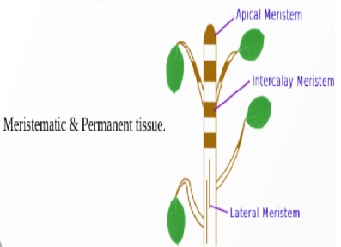
The tissue is a group of cells having similar origin, structure\& function. Study of tissues is called Histology. In unicellular organism (Amoeba) single cell performs all basic functions, whereas in multi-cellular organisms (Plants and Animals) shows division of labour as Plant tissue \& Animal tissues. Plant tissues are two types:
Image
Meristematic tissue:
The meristems are the tissues having the power of cell division. It is found on that region of the plant which grows.
Following are the types of Meristems:
The Apical meristems- It is present at the growing tip of the stem and roots and increases the length.
The lateral meristems- It present at the lateral side of stem and root (cambium) and increases the girth.
The intercalary meristems- It present at internodes or base of the leaves and increases the length between the nodes.
i. Which tissue help in the secondary growth of the plant?
ii. In what region of the plant does intercalary meristematic growth occur?
iil. Where does meristematic tissue mostly found in a plant?


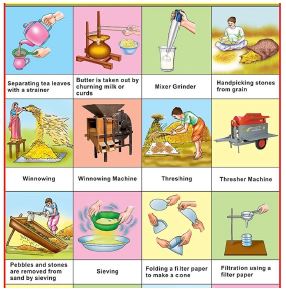
A Chemistry teacher explained the different types of separation of mixtures with the help of given adjoined chart. Now, in a practical test, students were provided with give samples and they were asked to separate the samples applying suitable separation methods. Now the students have to select the correct methods of separation.
$(i)$ Fine mud particles suspended in water.
$(a)$ Winnowing $(b)$ Sedimentation and Decantation
$(c)$ Using a magnet $(d)$ Chlorination
$(ii)$ Oil from water.
$(a)$ Sedimentation and Decantation $(b)$ Filtration
$(c)$ Separating funnel $(d)$ Winnowing
$(iii)$ Sodium chloride from its solution in water.
$(a)$ Filtration $(b)$ Separating funnel
$(c)$ Sedimentation and Decantation $(d)$ Evaporation
$(iv)$ Camphor from salt.
$(a)$ Filtration $(b)$ Separating funnel $(c)$ Sublimation $(d)$ Sedimentation
$(v)$ Cream from milk
$(a)$ Separating funnel $(b)$ Sedimentation $(c)$ Filtration $(d)$ Centrifugation
‘scientific’ name for organisms in the same manner that chemical symbols and formulae for various substances are used in the world. The scientific name for an organism is thus unique and can be used to identify it anywhere in the world.The system of scientific naming or nomenclature we use today was introduced by Carolus Linnaeus in the eighteenth century. The scientific name of an organism isthe process of classification which puts it along with the organisms it is most related to. But when we actually name the species, we do not list out the whole hierarchy of groups it belongs to. Instead, we limit ourselves to writing the name of the genus and species of that particular organism. World over, it has been agreed that both these names will be used in Latin forms.
Certain conventions are followed while writing the scientific names:
(1) The name of the genus begins with a capital letter.
(2) The name of the species begins with a small letter.
(3) When printed, the scientific name is given in italics.
(4) When written by hand, the genus name and the species name have to be underlined separately.
(1) The system of scientific naming or nomenclature we use today was introduced by
$(a)$ Carolus Linnaeus
$(b)$ Ernst Haeckel
$(c)$ Robert Whittaker
$(d)$ Carl Woese
(2) When scientific name is printed is given in
$(a)$ Bold
$(b)$ Italics
$(c)$ Italic in lowercase
$(d)$ Bold in uppercase
(3) Identify the correct statement
Statement $1$ – Name of the genus begins with a capital letter.
Statement $2$ – Name of the species begins with a small letter.
Statement $3$ –Name of the genus begins with a small letter
Statement $4$ –When printed, the scientific name is given in bold
$(a)$ Both $1$ & $3$
$(b)$ Both $3$ & $4$
$(c)$ Both $1$ & $2$
$(d)$ All of the above
(4) Why is there a need for systematic naming of living organisms?
(5) Which rules and conventions are need to be followed while writing the scientific names?
Newton’s first law of motion states that a body at rest will remain at rest position only and a body which is in motion continues to be in motion unless otherwise they are acted upon by an external force. In other words, all objects resist a changein their state of motion. In a qualitative way, the tendency of undisturbed objects to stayat rest or to keep moving with the same velocity is called inertia. This is why, the firstlaw of motion is also known as the law of inertia. Answer the following questions.
(i) The first law of motion is also known as
$(a)$law of inertia/p>
$(b)$law of thermodynamics
$(c)$both $a$ and $b$
$(d)$none of these
(ii) If no external force acts on object which is at rest. it will
$(a)$remain at rest
$(b)$start to move
$(c)$both a and b can possible
$(d)$none of these
(iii) If no external force acts on moving object. it will
$(a)$stop moving
$(b)$continue to move with same speed in same direction
$(c)$changes its direction of motion
$(d)$none of these
(iv) State Newton’s first law of motion.
(v) why Newton’s first law of motion is called law of inertia
Read the following text carefully and answer the questions that follow:
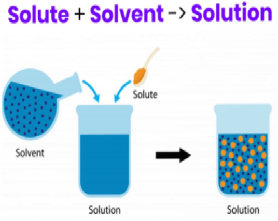
A solution of a solid in a liquid such as water can be prepared by adding it slowly to water with constant stirring at a certain temperature (room temperature). If the addition process is continued, a stage is ultimately reached in the dissolution process when no more of the solid dissolves. Rather it starts setlling at the bottom of the container such as a glass beaker. The solution at this stage is said to be saturated. The solubility of a solute is always expressed with respect to the saturated solution. It may be defined as the maximum amount of the solute that can be dissolved in 100 g of the solvent to form a saturated solution at a given temperature. Please remember that the role of temperature is very important. If temperature is increased, the solution becomes unsaturated. In case the temperature is decreased, the solution becomes supersaturated. As a result, crust of the solute gets deposited on the surface.
i. What do mean by the term Solubility?
ii. 20 g of a solute are dissolved in 500 g of the solvent. The solubility of the solute is:
iii. When a saturated solution becomes unsaturated?
OR
What do you mean by concentration of solution?
Oxygen is a very abundant element on our Earth. It is found in the elemental form in the atmosphere to the extent of $21\%.$ It also occurs extensively in the combined form in the Earth’s crust as well as also in the air in the form of carbon dioxide. In the crust, it is found as the oxides of most metals and silicon, and also as carbonate, sulphate, nitrate and other minerals. It is also an essential component of most biological molecules like carbohydrates, proteins, nucleic acids and fats (or lipids).When we talk of the oxygen-cycle, we are mainly referring to the cycle that maintains the levels of oxygen in the atmosphere. Oxygen from the atmosphere is used up in three processes, namely combustion, respiration and in the formation of oxides of nitrogen. Oxygen is returned to the atmosphere in only one major process, that is, photosynthesis. And this forms the broad outline of the oxygen-cycle in nature.
Though we usually think of oxygen as being necessary to life in the process of respiration, it might be of interest to you to learn that some forms of life, especially bacteria, are poisoned by elemental oxygen. In fact, even the process of nitrogen-fixing by bacteria does not take place in the presence of oxygen.
(1) How much oxygen is present in our atmosphere?
$(a) 20 \%$
$(b) 21 \%$
$(c) 22 \%$
$(d) 23 \%$
(2) Identify the correct statement
Statement $1 –$ Oxygen is also an essential component of most biological molecules.
Statement $2 –$ Oxygen is returned to the atmosphere through process called photosynthesis
Statement $3 –$ Oxygen -cycle maintains the levels of oxygen in the atmosphere.
Statement $4 –$ Our atmosphere have $21 \%$ oxygen.
$(a)$ Only $1$
$(b)$ Both $2$ & $3$
$(c)$ Both $1$ & $4$
$(d)$ All of the above
(3) Oxygen from the atmosphere is used up in three main processes,
$(a)$ Combustion
$(b)$ Respiration
$(c)$ Formation of oxides of nitrogen
$(d)$ All of the above
(4) By which process Oxygen is returned to the atmosphere
$(a)$ Respiration
$(b)$ Photosynthesis
$(c)$ Photolysis
$(d)$ None of the above
(5) Write the molecular formula of oxygen?
Homogeneous mixtures are regarded as solutions or true solutions. Heterogeneous mixtures are of two types. These are suspensions and colloidal solutions. These differ in the size of the particles responsible for the difference in their properties. In a suspension, the particle size is more than $10^{-5} cm$ whereas in a colloidal solution, it ranges between $10^{-5} cm$ to $10^{-7} cm$. The two phases which constitute colloidal solutions, are dispersed phase and dispersion medium. Based upon their nature, the colloidal solutions are classified into eight types. The mixture of the non-reacting gases is always homogeneous irrespective of their nature. Therefore, it is not a colloidal solution.
i. Scattering of light occurs when a beam of light is passed through Blood. Why?
ii. What is Tyndall effect?
iii. What is called colloidal solution?
OR
Give an example of colloidal solution and identified their dispersed phase and dispersion medium?
The sum of momentum of the two objects before collision is equal to the sum of momentum after the collision provided there is no external unbalanced force acting on them. This is known as the law of conservation of momentum. This statement can alternatively be given as the total momentum of the two objects is unchanged or conserved by the collision. Law of conservation of momentum is applicable to system of particle. Answer the following questions.
(i)Law of conservation of momentum is applicable to
$(a)$ A system of particles
$(b)$ Only for $2$ particles
$(c)$ Only for $1$ particle
$(d)$ None of the above
(ii) Law of conservation of momentum holds good provided that
$(a)$ There should be external unbalanced force acting on particles
$(b)$ There should not be any external unbalanced force acting on particles
$(c)$ No internal forces acting on particles
$(d)$ None of the above
(iii)The total momentum of the two objects when collision occurs is
$(a)$ Changed
$(b)$ Remains conserved
$(c)$ Become zero
$(d)$ None of the above
(iv) State law of conservation of momentum.
(v) If action and Reaction are equal in magnitude and opposite in direction then why they do not cancel each other?