MCQ
We write the relation for Boyle's law in the form $PV = C$ when the temperature remains constant. In this relation, the magnitude of $C$ depends upon
  • A
    The nature of the gas used in the experiment
  • B
    The magnitude of $g$ in the laboratory
  • C
    The atmospheric pressure
  • The quantity of the gas enclosed

Answer

Correct option: D.
The quantity of the gas enclosed
d
In Boyle's law, while writing the reaction, the magnitude of $C$ depends upon the quantity of gas enclosed within.

Need a full question paper?

Generate a complete, print-ready paper with questions like this in minutes — across 16+ boards, with answer keys.

Start Generating Free

Similar questions

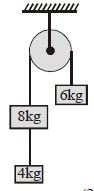
Three blocks of masses $4\,kg$, $6\,kg$ and $8\,kg$ are hanging over a fixed pulley as shown. The tension in the string connecting $8\,kg$ and $4\,kg$ block is
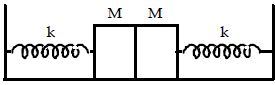
An assembly of identical spring-mass systems is placed on a smooth horizontal surface as shown. Initially the springs are relaxed. The left mass is displaced to the left while the right mass is displaced to the right and released. The resulting collision is elastic. The time period of the oscillations of the system is :-
The dimensional formula of latent heat is:
The orbital velocity of a satellite orbiting near the surface of the earth is given by:
If the frequency of an object in uniform circular motion is doubled, its acceleration becomes
The gas thermometers are more sensitive than liquid thermometers because
The position vector of a particle $\vec R$ as a function of time is given by $\overrightarrow {\;R} = 4\sin \left( {2\pi t} \right)\hat i + 4\cos \left( {2\pi t} \right)\hat j$ where $R$ is in meters, $t$ is in seconds and  $\hat i$ and $\hat j$  denote unit vectors along $x-$ and $y-$directions, respectively. Which one of the following statements is wrong for the motion of particle? 
A Carnot engine absorbs an amount $Q$ of heat from a reservoir at an abosolute temperature $T$ and rejects heat to a sink at a temperature of $T/3.$ The amount of heat rejected is
A closed vessel contains $8\,gm$ of oxygen and $7\,gm$ of nitrogen. The total pressure is $10\, atm$ at a given temperature. If now oxygen is absorbed by introducing a suitable absorbent the pressure of the remaining gas in atm will be