MCQ
Weight of a body is maximum at
  • A
    Moon
  • Poles of earth
  • C
    Equator of earth
  • D
    Centre of earth

Answer

Correct option: B.
Poles of earth
b
(b) We know that the weight of the body is the product of mass and acceleration due to gravity and the acceleration due to gravity increases with the latitude

Now the latitude is minimum at the equator and maximum at the poles So, acceleration due to gravity and hence weight is maximum at the poles and minimum at the equator

Hence correct answer is option $A$

Need a full question paper?

Generate a complete, print-ready paper with questions like this in minutes — across 16+ boards, with answer keys.

Start Generating Free

Similar questions

A swimmer crosses a river of width $d$ flowing at velocity $v$. While swimming, he heads himself always at an angle of $120^{\circ}$ with the river flow and on reaching the other end he finds a drift of $d / 2$ in the direction of flow of river. The speed of the swimmer with respect to the river is
Two bodies $A$ and $B$ collide as shown in Fig. $(i)$ and $(ii)$ Which statement is true ?
The intensity of the gravitational field at a distance $r$ from the center of a spherical shell of mass M and radius $R (r< R )$ will be :
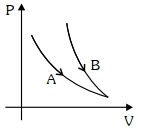
Choose the correct statement for processes $A$  & $B$ shown in figure.
A balloon of mass $m$ is descending down with an acceleration $\frac{g}{2}$.  How much mass should be removed from it so that it starts moving up with same acceleration?
Three liquids of densities $d, 2d$ and $3d$ are mixed in equal proportion of weights. If density of water is $d,$ then the specific gravity of the mixture is:
A projectile is thrown with velocity $v$ at an angle $\theta$ with horizontal. When the projectile is at a height equal to half of the maximum height, the vertical component of the velocity of projectile is ...........
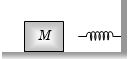
The block of mass $M$  moving on the frictionless horizontal surface collides with the spring of spring constant $K$ and compresses it by length $L$. The maximum momentum of the block after collision is
The second's hand of a watch has $6\, cm$ length. The speed of its tip and magnitude of difference in velocities of its at any two perpendicular positions will be respectively
Which of the following statements is incorrect?