MCQ
Weight of a body is maximum at
  • A
    Moon
  • Poles of earth
  • C
    Equator of earth
  • D
    Centre of earth

Answer

Correct option: B.
Poles of earth
b
(b) We know that the weight of the body is the product of mass and acceleration due to gravity and the acceleration due to gravity increases with the latitude

Now the latitude is minimum at the equator and maximum at the poles So, acceleration due to gravity and hence weight is maximum at the poles and minimum at the equator

Hence correct answer is option $A$

Need a full question paper?

Generate a complete, print-ready paper with questions like this in minutes — across 16+ boards, with answer keys.
Start Generating Free

Similar questions

Electron of mass $m$ and charge $q$ is travelling with a speed along a circular path of radius $r$ at right angles to a uniform magnetic field of intensity $B$. If the speed of the electron is doubled and the magnetic field is halved the resulting path would have a radius
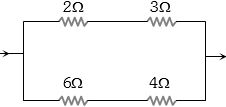
In the circuit as shown in the figure, the heat produced by $6\, ohm$ resistance due to current flowing in it is $60$ calorie per second. The heat generated across $3\, ohm$ resistance per second will be ................. $calorie$
Assertion : Kirchoff 's junction rule follows from conservation of charge.

Reason : Kirchoff 's loop rule follows from conservation of momentum.
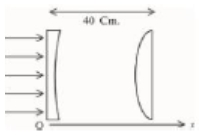
As shown in the figure, a combination of a thin plano concave lens and a thin plano convex lens is used to image an object placed at infinity. The radius of curvature of both the lenses is $30\,cm$ and refraction index of the material for both the lenses is $1.75$. Both the lenses are placed at distance of $40\,cm$ from each other. Due to the combination, the image of the object is formed at distance $x =..........cm$, from concave lens.
Correct order for nucleophilic addition reaction :

$(1)$ $\begin{matrix}
   O  \\
   ||  \\
   {{C}_{6}}{{H}_{5}}-C-{{C}_{6}}{{H}_{5}}  \\
\end{matrix}$

$(2)$ $C _{6} H _{5}- CHO$

$(3)$ $p - CH _{3}- C _{6} H _{4}- CHO$

$(4)$ $p - CH _{3} O - C _{6} H _{4}- CHO$

Given below are two statements : one is labeled as Assertion $A$ and the other is labeled as Reason $R$

Assertion $A:$ Photodiodes are used in forward bias usually for measuring the light intensity.

Reason $R:$ For a $p-n$ junction diode, at applied voltage $V$ the current in the forward bias is more than the current in the reverse bias for $\left|V_z\right| > \pm V \geq\left|V_0\right|$ where $V_0$ is the threshold voltage and $V _{ z }$ is the breakdown voltage.

In the light of the above statements, choose the correct answer from the options given below
Five particles have speeds $1, 2, 3, 4, 5 \,\,m/s$. the average velocity of the particles is (in $m/s$)
Two forces $3\,N$ and $2\, N$ are at an angle $\theta$ such that the resultant is $R$. The first force is now increased to $ 6\,N$ and the resultant become $2R$. The value of is ....... $^o$
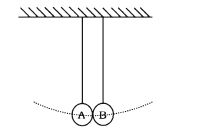
Two pendulums with identical bobs and lengths are suspended from a common support such that in rest position the two bobs are in contact (figure). After being displaced by $5^o $ the bob $A$ is released from rest, at $t = 0$ subsequently it collides elastically head-on with the other bob.The graph showing variation in energy of pendulum $A$ with time, for $0 \leqslant t \leqslant T$ (where $T$ is the period of either pendulum).
When the $rms$ voltages $V_L, V_C$ and $V_R$ are measured respectively across the inductor $L$, the capacitor $C$ and the resistor $R$ in a series $LCR$ circuit connected to an $AC$ source, it is found that the ratio $V_L : V_C : V_R = 1 : 2 : 3$. If the $rms$ voltage of the $AC$ sources is $100\, V$, the $V_R$ is close to........$V$