MCQ
Weightlessness experienced while orbiting the earth in space-ship, is the result of
  • A
    Inertia
  • B
    Acceleration
  • C
    Zero gravity
  • Free fall towards earth

Answer

Correct option: D.
Free fall towards earth
d
(d)

Need a full question paper?

Generate a complete, print-ready paper with questions like this in minutes — across 16+ boards, with answer keys.
Start Generating Free

Similar questions

Inside a horizontally moving box, an experimenter finds that when an object is placed on a smooth horizontal table and is released, it moves with an acceleration of $10\,m / s ^2$. In this box if $1\,kg$ body is suspended with a light string, the tension in the string in equilibrium position (w.r.t. experimenter) will be$.........\,N$ (Take $g =10\,m / s ^2$ )
The range of strong nuclear force is about:
An air bubble of volume $1.0\; cm ^{3}$ rises from the bottom of a lake $40\; m$ deep at a temperature of $12\,^{\circ} C$. To what volume (in $cm^3$) does it grow when it reaches the surface, which is at a temperature of $35\,^{\circ} C ?$
A simple harmonic wave having an amplitude a and time period $T$ is represented by the equation $y = 5\sin \pi (t + 4)m.$ Then the value of amplitude $(a)$ in $(m)$ and time period $(T) $ in second are
The earth revolves round the sun in one year. If the distance between them becomes double, the new period of revolution will be
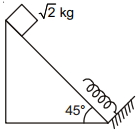
A block of mass $\sqrt{2}\,kg$ is released from the top of an inclined smooth surface as shown in figure. If spring constant of spring is $100\,N / m$ and block comes to rest after compressing the spring by $1 \,m$, then the distance travelled by block before it comes to rest is ......... $m$
Weight of a body of mass m decreases by $1\%$ when it is raised to height $h$ above the earth’s surface. If the body is taken to a depth h in a mine, change in its weight is
Which of the following $($referred to a spherical mirror$)$ do $($does$)$ not depend on whether the rays are paraxial or not?
As the mass number A increases, the binding energy per nucleon in a nucleus:
The gases carbon monoxide $(CO)$ and nitrogen $(N_2)$ at the same temperature have kinetic energies $E_1$ and $E_2Z,$ respectively. Then,