Question
What are alcohol, phenol and ether compounds ?

Answer

$\rightarrow$ Alcohol compounds: An alcohol contains one or more hydroxyl $(OH)$ group$(s)$ directly attached to carbon atom$(s),$ of an aliphatic system. For example$, \ce{CH3OH}$.
$\rightarrow$ Phenol compounds: A phenol contains one or more hydroxyl $(OH)$ group$(s)$ directly attached to carbon atom$(s),$ of an aromatic system. For example$, \ce{C6H5OH}$
$\rightarrow$ Alcohol compounds: The substitution of a hydrogen atom in a hydrocarbon by an alkoxy or aryloxy group $(R-O/Ar-O)$ yields another class of compounds known as 'ethers', for example, dimethyl ether $(\ce{CH3OCH3})$.
$\rightarrow$ In short, ether is a compound which is formed by substituting the hydrogen atom of hydroxyl group of an alcohol or phenol by an alkyl or aryl group.

Need a full question paper?

Generate a complete, print-ready paper with questions like this in minutes — across 16+ boards, with answer keys.
Start Generating Free

Similar questions

What happens when
i. n-butyl chloride is treated with alcoholic KОН.
ii. bromobenzene is treated with Mg in the presence of dry ether.
iii. chlorobenzene is subjected to hydrolysis.
Predict the order of reactivity of the four isomeric bromobutanes in $S_N1$ and $S_N2$ reactions.
Determine the osmotic pressure of a solution prepared by dissolving $25\ mg$ of $K_2SO_4$ in $2$ litre of water at $25^\circ C,$ assuming that it is completely dissociated.
Calculate the electrode potential of copper electrode dipped in $0.1\ce{M CuSO_4}$ solution at $298K.$ Given that $\text{E}^{\circ}_{\text{cu}^{2}+/\text{cu}}=0.34\text{V}.$
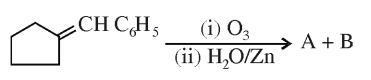
(i) Complete the following reaction :
Image
(ii) Write the structure of two isomers formed by the reaction of acetophenone with hydroxyl amine.
Calculate the mass of ascorbic acid $($Molar mass $= 176\text{g mol}^{-1})$ to be dissolved in $75g$ of acetic acid, to lower its freezing point by $1·5^\circ C. (K_f = 3.9K \ \text{kg mol}^{-1})$
Discuss the formation of amine compounds by reduction of nitrile and amide compounds.
Calculate the standard cell potentials of galvanic cell in which the following reactions take place:
$Fe^{2+}(aq) + Ag^+ (aq) \rightarrow Fe^{3+}(aq) + Ag(s)$
Calculate the $\triangle_\text{r}\text{G}^\ominus$ and equilibrium constant of the reactions.
Write about oxidation states of transition series ?
Give the plausible explanation for the following :
(a) Glucose does not give 2,4-DNP test.
(b) The two strands in DNA are not identical but are complementary.
(c) Starch and cellulose both contain glucose unit as monomer, yet they are structurally different.