Question
  1. What are beats? Name the basic phenomenon due to which beats are produced.
  2. Two sources of sound are producing waves of frequency n1 and n2, where (n1 - n2) is small, show mathematically that the beat frequency is (n1 - n2).

Answer

  1. Beats: The waxing and waning of sound due to interaction between two slightly different frequencies. If y, and v, are the two frequencies vb = |v1 - v2|.

Beats are heard only when |v1 - v2l< 10, since the sound persist in our ears for $\frac{1}{10}\text{th}$ of a second.

  1. When n, and n, are two frequencies represented by $\text{y}_1=\text{A}\sin2\pi\text{n}_1\text{t}$ and $\text{y}_2=\text{A}\sin2\pi\text{n}_2\text{t},$ we get on superposition,

$\text{y}=\text{y}_1+\text{y}_2$

$=2\text{A}\cos\pi\Big(\frac{\text{n}_1-\text{n}_2}{2}\Big)\text{t}\sin2\pi\Big(\frac{\text{n}_1\text{n}_2}+{2}\Big)\text{t}$

Amplitude $=2\text{A}\cos2\pi\Big(\frac{\text{n}_1-\text{n}_2}{2}\Big)\text{t}$ becomes maximum, when $2\pi\text{t}\Big(\frac{\text{n}_1-\text{n}_2}{2}\Big)=0,2\pi...\text{N}\pi\text{ i.e., }\text{n}_1-\text{n}_2=\frac{2\text{N}\pi}{2\pi\text{t}}=\frac{\text{N}}{\text{t}}=\text{N}.$ n where n is the beat frequency-the number of times the maxima and minima is repeated in one second. 

Need a full question paper?

Generate a complete, print-ready paper with questions like this in minutes — across 16+ boards, with answer keys.

Start Generating Free

Similar questions

A 10g bullet with a charge of $4.00\mu\text{C}$ is fired at a speed of 270m/s-1 in a horizontal direction. A vertical magnetic field of $500\mu\text{T}$ exists in the space. Find the deflection of the bullet due to the magnetic field as it travels through 100m. Make appropriate approximations.
A bucket full of water is placed in a room at 15°C with initial relative humidity 40%. The volume of the room is 50m3.
  1. How much water will evaporate?
  2. lf the room temperature is increased by 5°C, how much more water will evaporate? The saturation vapour pressure of water at 15°C and 20°C are 1.6kPa and 2.4kPa respectively.
A body of mass 2kg is lying on a rough inclined plane of inclination 30°. Find the magnitude of the force parallel to the incline needed to make the block move:
  1. Up the incline
  2. Down the incline. Coefficient of static friction = 0.2.
Define banking of roads. Derive an expression for maximum velocity of a car on a banked circular road having co-efficient of friction $\mu.$

OR

A man of mass 70kg stands on a weighing scale in a lift which is moving,
  1. Upwards with a uniform speed of 10ms-1.
  2. Downward with a uniform acceleration of 5ms-2.
  3. Upward with a uniform acceleration of 5ms-2 What would be the readings on the scale in each case?
  4. What would be the reading if the lift mechanism failed and it hurtled down freely under gravity?
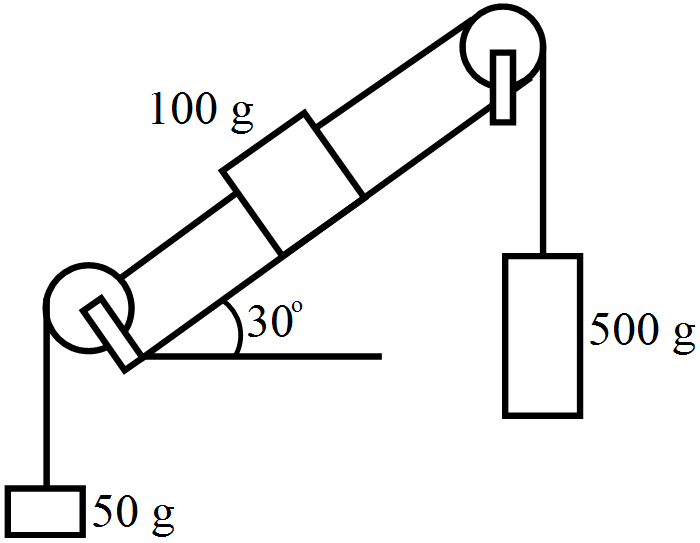
Find the acceleration of the 500g block in figure.

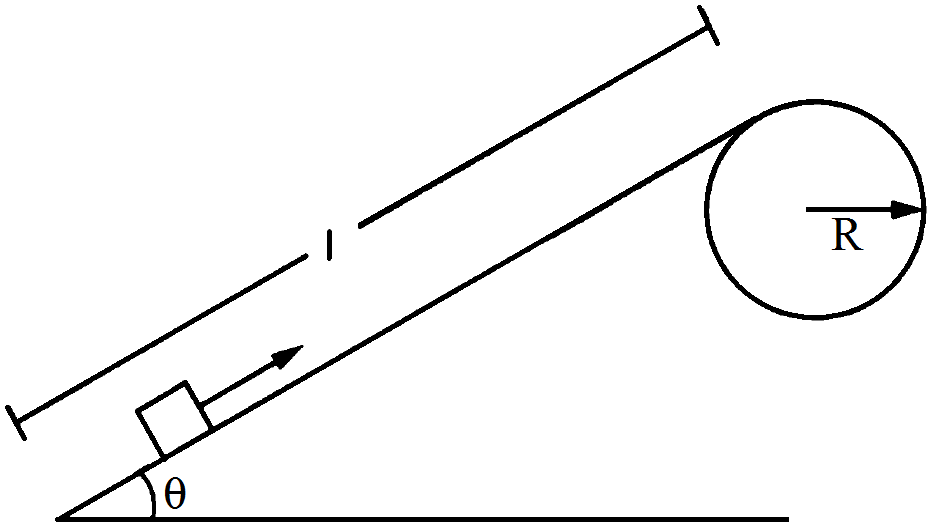
A particle of mass m is kept on the top of a smooth sphere of radius R. It is given a sharp impulse which imparts it a horizontal speed v.
  1. Find the normal force between the sphere and the particle just after the impulse.
  2. What should be the minimum value of v for which the particle does not slip on the sphere?
  3. Assuming the velocity v to be half the minimum calculated in part.
  4. Find the angle made by the radius through the particle with the vertical when it leaves the sphere.

Calculate the velocity of liquid flowing through a pilot tube.
A particle of mass m is executing simple harmonic oscillations of amplitude A. At $\text{x}=\frac{\text{A}}{2}$ what fraction of its energy is potential? What fraction is kinetic?
A ball of mass m, moving with a speed 2v0, collides inelastically (e > 0) with an identical ball at rest. Show that:
For a general collision, the angle between the two velocities of scattered balls is less than 90°
A ball is thrown from a point in level with and at a horizontal distance r from the top of a tower of height H. How must the speed and angle of projection of the ball be related to r in order that the ball may just go grazing past the top edge of the tower? At what horizontal distance x from the foot of the tower does the ball hit the ground ? For a given speed of projection, obtain an equation for finding the angle of projection so that x is at a minimum.