Question
What are biodegradable and non-biodegradable pollutants?

Answer

Biodegradable pollutants:
Those pollutants which can be broken down into simpler, harmless, substances in nature in due course of time (by the action of micro-organisms like certain bacteria) are called biodegradable pollutants. Domestic wastes (garbage), urine, faecal matter, sewage, agriculture residues, paper, wood, cloth, cattle dung, animal bones, leather, wool, vegetable stuff or plants are biodegradable pollutants.
Non-biodegradable pollutants:
Those pollutants which cannot be broken down into simpler, harmless substances in nature are called non-biodegradable pollutants. DDT, plastics, polythene, bags, insecticides, pesticides, mercury, lead, and arsenic, metal articles like aluminum cans, synthetic fibres, glass objects, iron products and silver foils are non-biodegradable pollutants.

Need a full question paper?

Generate a complete, print-ready paper with questions like this in minutes — across 16+ boards, with answer keys.
Start Generating Free

Similar questions

  1. A gas occupies a volume of 4 L at $8 \times 10^5Nm^{-2}$. Calculate the additional pressure required to decrease the volume of the gas to $2.5L$. keeping the temperature constant.
  2. Which of the following gas will hale smaller value of van der Waals' constant a?
  1. Ne
  2. $NH_3$
  1. The size of a weather balloon changes as it rises. What change is expected in its size and why?
Explain various methods to form alkene.
  1. The energy associated with Bohr's first orbit is $-2.18 \times 10^{-18}J atom^{-1}$. What is the energy associated with fifth orbit?
  2. The work function for Caesium atom is $1.9 eV$.
Calculate the threshold wavelength.
[Given: $1 eV = 1.6 × 10⁻¹⁹J$]
  1. How many subshells are associated with $n = 4$?
1. Will $CCl _4$ give a white precipitate of AgCl on heating it with $AgNO _3$ ?
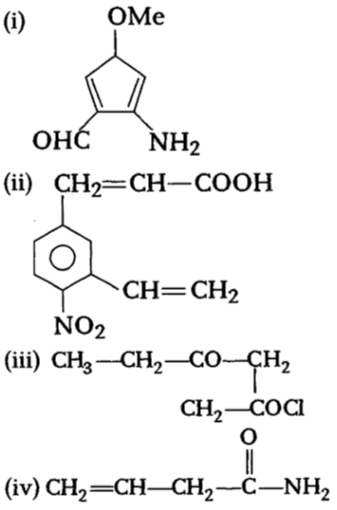
2. Identify the functional groups present in the following compounds.
Image
Write Lewis structure of the following compounds and show formal charge on each atom. $\mathrm{HNO}_3, \mathrm{NO}_2, \mathrm{H}_2 \mathrm{SO}_4$.
Match the species in Column I with the type of hybrid orbitals in Column II.
 
Column I
 
Column II
i.
NO
a.
1.5
ii.
CO
b.
2.0
iii.
$\text{O}^{-}_{2}$
c.
2.5
iv.
$\text{O}_{2}$
d.
3.0
What is the equilibrium concentration of each of the substances in the equilibrium when the initial concentration of ICl was 0.78M?
$2\text{ICI (g)}\rightleftharpoons\text{I}_2\text{ (g) + Cl}_2\text{ (g)};\text{ K}_{\text{c}}=0.14$
  1. Calculate the wavelength and frequency of limiting line of Lyman series (Rydberg constant = $109677 \mathrm{~cm}^{-1}$)
  2. Give quantum numbers for electrons with highest energy in sodium atom (Z = 11)
  3. Which of the following sets of quantum numbers are not possible? Give reasons:
  1. $\text{n} =1,1=0,\text{m}_1=0,\text{m}_\text{s}=-\frac{1}{2}$
  2. $\text{n}=0,1=0,\text{m}_1=0,\text{m}_\text{s}=-\frac{1}{2}$
Reaction between $N_2$ and $O_{2–}$ takes place as follows:
$\text{2N}_2\text{(g) + O}_2\text{(g)}\rightleftharpoons2\text{N}_2\text{O(g)}$
If a mixture of 0.482mol $N_2$ and 0.933mol of $O_2$ is placed in a 10L reaction vessel and allowed to form $N_2O$ at a temperature for which $\text{K}_{\text{c}}=2.0\times10^{-37},$ determine the composition of equilibrium mixture.
Write short notes on the following:
(a) Sigma and pi bond
(b) Dipole torque
(c) Polarity of the bond.