Question
What are circular and elliptically polarized light?

Answer

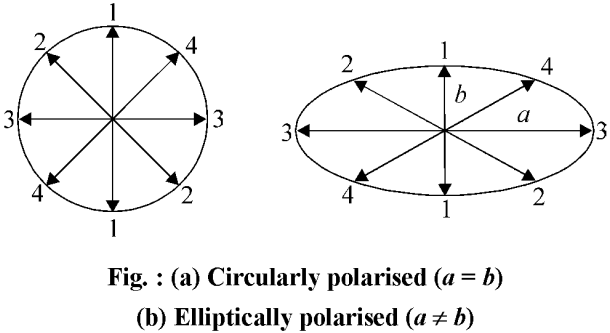
Circularly polarized light : When two plane polarized light rays are superimposed on each other under special circumstances in such a way that the resulting light vector starts rotating by a certain magnitude in a plane perpendicular to the direction of wave propagation, then the displacement of vibration in the light vector occurs in the form of a circle. Such light is called circularly polarized light. In this, the magnitude of the electric vector remains constant but its direction keeps changing regularly.

Image
Elliptically polarized light : When two plane polarized light rays are superimposed on each other under special circumstances in such a way that the resulting light vector starts rotating with a changed magnitude in a plane perpendicular to the direction of wave propagation, then the vibrational displacement of the light vector occurs in an ellipse. Such light is called elliptically polarized light.

Need a full question paper?

Generate a complete, print-ready paper with questions like this in minutes — across 16+ boards, with answer keys.
Start Generating Free

Similar questions

When a p-type impurity is doped in a semiconductor, a large number of holes are created. This does not make the semiconductor charged. But when holes diffluse from the p-side to the n-side in a p-n junction, the n-side gets positively charged. Explain.
A sample of HCl gas is placed in an electric field of $2.5 \times 10^4 \mathrm{NC}^{-1}$. The dipole moment of each HCl molecule is $3.4 \times 10^{-30} \mathrm{Cm}$. Find the maximum torque that can act on a molecule.
A parallel plate capacitor is filled by a dielectric whose relative permittivity varies with the applied voltage (U) as $\in=\alpha\text{U}$ where $\alpha=2\text{V}^{-1}$. A similar capacitor with no dielectric is charged to $U_0= 78V.$ It is then connected to the uncharged capacitor with the dielectric. Find the final voltage on the capacitors.
If we walk barefoot on a nylon mat for some time and touch the metal handle of a door, we get an electric shock. Why does this happen?
Can simple harmonic motion take place in a noninertial frame? If yes, should the ratio of the force applied with the displacement be constant?
Using Huygens principle, write Snell's law related to refraction of plane waves.
A rubber balloon is given a charge Q distributed uniformly over its surface. Is the field inside the balloon zero everywhere if the balloon does not have a spherical surface?
$q_1$ and $q_2$ are point charges such that $q_1 \times q_2>9$. What is the nature of the force between the two charges?
Consider the energy density in a solenoid at its centre and that near its ends. Which of the two is greater?
Which types of fields are produced by a moving electron? If electron is at rest, then what type of field is produced?