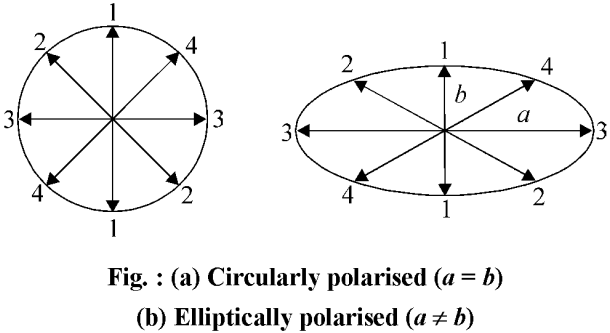
Question
What are circular and elliptically polarized light?

Need a full question paper?

Generate a complete, print-ready paper with questions like this in minutes — across 16+ boards, with answer keys.
Start Generating Free

Similar questions

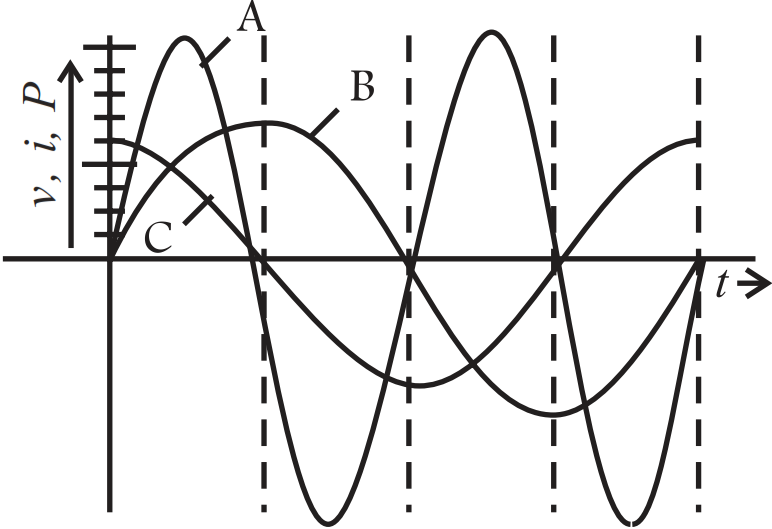
A device 'X' is connected to an a.c source. The variation of voltage, current and power in one complete cycle is shown in Fig.
  1. Which curve shows power consumption over a full cycle?
  2. What is the average power consumption over a cycle?
  3. Identify the device 'X'.
A neutron star has a density equal to that of the nuclear matter. Assuming the star to be spherical, find the radius of a neutron star whose mass is $4.0 \times 10^{30}kg ($twice the mass of the sun$).$
Potassium $-40$ can decay in three modes. It can decay by $\beta^-$ emission, $\beta^+$ emission of electron capture.
  1. Write the equations showing the end products.
  2. Find the $Q-$ values in each of the three cases. Atomic masses of $\text{ }^{40}_{18}\text{Ar},\text{ }^{40}_{19}\text{K}$ and $\text{40}_{20}\text{Ca}$ are $39.9624u \ \ 39.9640u$ and $39.9626u$ respectively.
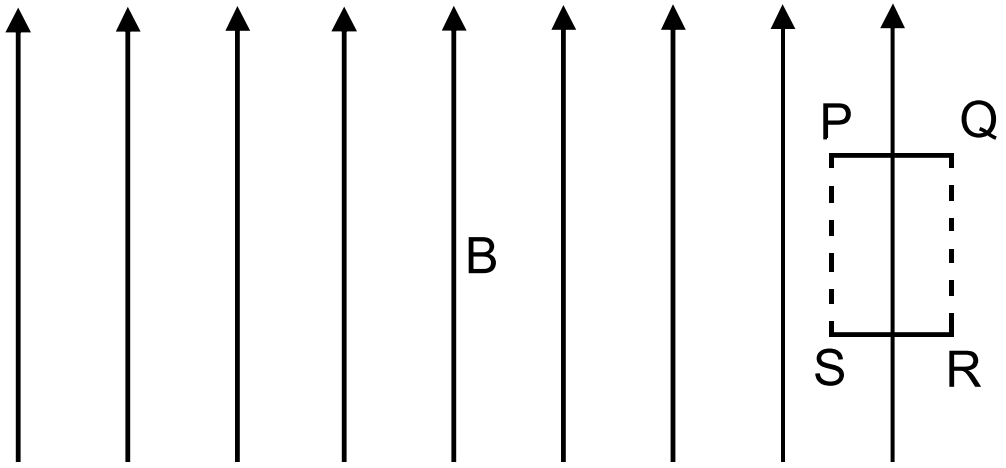
Sometimes we show an idealised magnetic field which is uniform in a given region and falls to zero abruptly. One such field is represented in figure. Using Ampere's law over the path PQRS, show that such a field is not possible.
Distinguish the magnetic properties of dia, para$-$ and ferro$-$magnetic substances in terms of $(i)$ susceptibility, $(ii)$ magnetic permeability and $(iii)$ coercivity. Give one example of each of these materials. Draw the field lines due to an external magnetic field near a $(i)$ diamagnetic, $(ii)$ paramagnetic substance.
A long cylindrical wire carries a positive charge of linear density $2.0 \times 10^{-8}Cm^{-1}.$ An electron revolves around it in a circular path under the influence of the attractive electrostatic force. Find the kinetic energy of the electron. Note that it is independent of the radius.
A point object $ 'O\ '$ is kept in a medium of refractive index $n_1$ in front of a convex spherical surface of radius of curvature $R$ which separates the second medium of refractive index $n_2$ from the first one, as shown in the figure.
  1. Draw the ray diagram showing the image formation and deduce the relationship between the object distance and the image distance in terms of $n_1, n_2$ and $R$.
  2. When the image formed above acts as a virtual object for concave spherical, surface separating the medium $n_2$ from $n_1 (n_2 > n_1),$ draw this ray diagram and write the similar $($similar to $(a)$ relation$)$. Hence obtain the expression for the lens maker's formula.
Four particles having masses m, 2m, 3m and 4m are placed at the four corners of a square of edge a. Find the gravitational force acting on a particle of mass m placed at the centre.
  1. In the explanation of photo electric effect, we asssume one photon of frequency $ν$ collides with an electron and transfers its energy. This leads to the equation for the maximum energy $E_\text{max}$ of the emitted electron as,
  1. $\text{E}_\text{max}=\text{hv}-\phi_0$
    where $\phi_0$ is the work function of the metal. If an electron absorbs $2$ photons $($each of frequency $ν)$ what will be the maximum energy for the emitted electron?
  2. Why is this fact $($two photon absorption$)$ not taken into consideration in our discussion of the stopping potential?

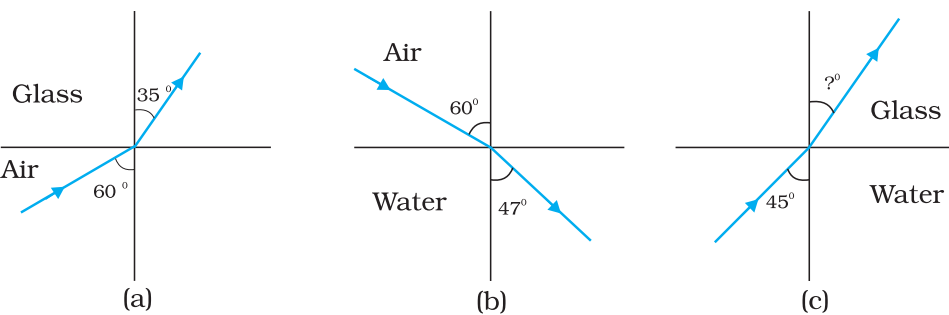
(a) and (b) show refraction of a ray in air incident at 60° with the normal to a glass-air and water-air interface, respectively. Predict the angle of refraction in glass when the angle of incidence in water is 45º with the normal to a water - glass interface.