Question
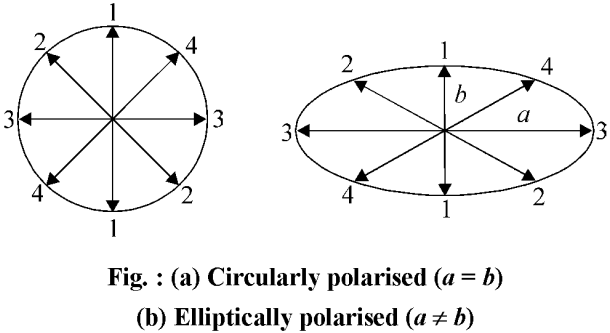
What are circular and elliptically polarized light?

Need a full question paper?

Generate a complete, print-ready paper with questions like this in minutes — across 16+ boards, with answer keys.

Start Generating Free

Similar questions

A pendulum clock gives correct time at 20°C at a place where g = 9.800m s-2. The pendulum consists of a light steel rod connected to a heavy ball. It is taken to a different place where g = 9.788m s-2. At what temperature will it give correct time ? Coefficient of linear expansion of steel = 12 × 10-6 °C-1.
a. Using the ray diagram for a system of two lenses of focal lengths $f_1$ and $f_2$ in contact with each other, show that the two lens system can be regarded as equivalent to a single lens of focal length $f$, where
 $\frac{1}{ f }=\frac{1}{ f _1}+\frac{1}{ f _2}$
Also write the relation for the equivalent power of the lens combination.
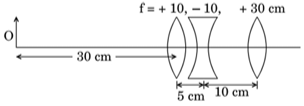
b. Determine the position of the image formed by the lens combination given in the figure. 
Image
i. Derive lens maker’s formula for a biconvex lens.
ii. A point object is placed at a distance of 12 cm on the principal axis of a convex lens of focal length 10 cm. A convex mirror is placed coaxially on the other side of the lens at a distance of 10 cm. If the final image coincides with the object, sketch the ray diagram, and find the focal length of the convex mirror.
Find the maximum magnifying power of a compound Microscope having a 25 diopter lens as the objective, a 5 diopter lens as the eyepiece and the separation 30cm between the two lenses. The least distance for clear vision is 25cm.
What is rivetted galvanometer? What is the function of shunt in a galvanometer?
k transparent slabs are arranged one over another. The refractive indices of the slabs are $\mu_1,\mu_2,\mu_3, \ ...\mu_{\text{k}}$ and the thicknesses are t1, t2, t3, ... tk . An object is seen through this combination with nearly perpendicular light. Find the equivalent refractive index of the system which will allow the image to be formed at the same place.
A myopic adult has a far point at 0.1m. His power of accomodation is 4 diopters.
  1. What power lenses are required to see distant objects?
  2. What is his near point without glasses?
  3. What is his near point with glasses? (Take the image distance from the lens of the eye to the retina to be 2cm.)
A uniform ladder of length 10.0m and mass 16.0kg is resting against a vertical wall making an angle of 37° with it. The vertical wall is frictionless but the ground is rough. An electrician weighing 60.0kg climbs up the ladder. If he stays on the ladder at a point 8.00m from the lower end, what will be the normal force and the force of friction on the ladder by the ground? What should be the minimum coefficient of friction for the elctrician to work safely?
A plane electromagnetic wave is passing through a region. Consider (a) electric field (b) magnetic field (c) electrical energy in a small volume and (d) magnetic energy in a small volume. Construct the pairs of the quantities that oscillate with equal frequencies.