Question
What are interstitial compounds? Why are such compounds well known for transition metals?

Answer

Transition metals form large number of interstitial compounds. They are able to entrap small atoms of elements like H, G, N, B, etc., in their crystal lattice and even can make weak bonds with them. Due to formation of interstitial compounds, their malleability and ductility decreases and tensile. strength increases. Steel and cast iron are hard in comparison to wrought iron due to the presence of trapped carbon atoms in interstitial spaces.
Need a full question paper?

Generate a complete, print-ready paper with questions like this in minutes — across 16+ boards, with answer keys.

Start Generating Free

Similar questions

For a reaction, the energy of activation is zero. What is the value of rate constant at 300K, if k = 1.6 × 10⁶ s –1 at 280K? [R = 8.31J K–1 mol–1].
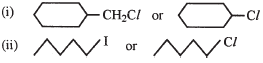
Which ones in the following pairs of substances undergoes SN2 substitution reaction faster and why?


Draw the pyramidal shape of trimethyl amine.
Write the equation to prepare Frankland reagent and tetramethyl lead from haloalkane.
How carboxylic acid is obtained from the hydrolysis of acyl chloride and acid anhydride? Give examples.
Two isomeric compounds (A and B) have $C _4 H _{11} N$ molecular formula react with $HNO _2$ and forms compounds (C) and (D). C is hardly oxidised but it reacts immediately with Lucas reagent whereas $D$ reacts with Lucas reagent in 5 minutes and it also gives haloform reaction. Identify $A, B, C$ and $D$.
How does electrolysis of molten NaCl occurs?
Thermodynamic feasibility of the reaction alone cannot decide the rate of the reaction. Explain with the help of one example.
For a reaction
$2\text{H}_2\text{O}_2\xrightarrow[\text{alkaline medium}]{\text{I}^-}2\text{H}_2\text{O}+\text{O}_2$
the proposed mechanism is as given below:
  1. $\text{H}_2\text{O}_2+\text{I}^{-}\xrightarrow{\ \ \ \ \ \ \ }\text{H}_2\text{O}+\text{IO}^{-}(\text{slow})$
  2. $\text{H}_2\text{O}_2+\text{IO}^{-}\xrightarrow{\ \ \ \ \ \ \ }\text{H}_2\text{O}+\text{I}^{-}+\text{O}_2(\text{fast})$
  1. Write rate law for the reaction.
  2. Write the overall order of reaction.
  3. Out of steps (1) and (2), which one is rate determining step?
What is the reaction of formic acid with the following :
(i) Concentrated $H _2 SO _4$
(ii) Aqueous $C l _{ 2 }$ (chlorine water)