Question
What are ionic and molecular compounds? Give examples.

Answer

Atoms of different elements join together in definite proportions to form molecules of compounds. Compounds can be either ionic compounds or molecular compounds.
Ionic compounds are those compounds that contain charged species of metals and nonmetals.
The charged species are known as ions.
An ion is a charged particle and can be negatively or positively charged.
A negatively charged ion is called an anion and the positively charged ion is called cation.
Ionic compounds are formed when ionic bonds are formed between different elements through transfer of electrons.
Examples of ionic compounds - sodium chloride, calcium oxide.
Molecular compounds or covalent compounds are those compounds in which the elements share electrons via covalent bonds.
Examples - water, ammonia, carbon dioxide.

Need a full question paper?

Generate a complete, print-ready paper with questions like this in minutes — across 16+ boards, with answer keys.

Start Generating Free

Similar questions

How could you  convince a small child that when ou speak, it is not necessary for air to travel from your mouth to the ear of a listener?
A boy walks from his classroom to the bookshop along a straight corridor towards North. He covers a distance of 20m in 25 seconds to reach the bookshop. After buying a book, he travels the same distance in the same time to reach back in the classroom. Find (a) average speed, and (b) average velocity, of the boy.
A car is travelling at $20\ m/s$ along a road. A child runs out into the road $50m$ ahead and the car driver steps on the brake pedal. What must the car's deceleration be if the car is to stop just before it reaches the child?
If one gram of sulphur contains $x$ atoms, calculate the number of atoms in one gram of oxygen element.
$($Atomic masses: $S = 32u; O = 16u)$

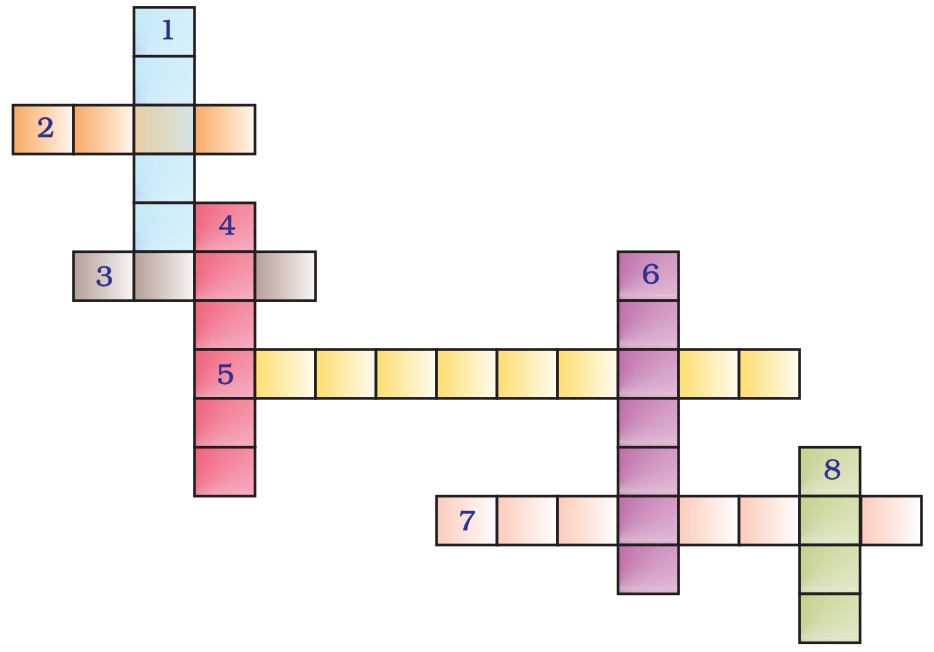
Complete the following crossword puzzle (Figure) by using the name of the chemical elements. Use the data given in the table following.
Across
Down
2.
The element used by Rutherford during his $\alpha$–scattering experiment.
1.
A white lustrous metal used for making ornaments and which tends to get tarnished black in the presence of moist air.
3.
An element which forms rust on exposure to moist air.
4.
Both brass and bronze are alloys of the element.
5.
A very reactive non–metal stored under water.
6.
The metal which exists in the liquid state at room temperature.
7.
Zinc metal when treated with dilute hydrochloric acid produces a gas of this element which when tested with burning splinter produces a pop sound.
8.
An element with symbol Pb.
A truck of mass $500\ kg$ moving at $4\ m/s$ collides with another truck of mass $1500\ kg$ moving in the same direction at $2\ m/s.$ What is their common velocity just after the collision if they move off together?
What is the role of SER in liver cells of vertebrates?
Which has more atoms, $50g$ of aluminium or $50g$ of iron$?$ Illustrate your answer with the help of calculations.
$($Atomic masses: $Al = 27u; Fe = 56u)$
Two objects having equal masses are moving with uniform velocities of 2m/s and 6m/s respectively. Calculate the ratio of their kinetic energies.
Discuss the method of separating a mixture containing chalk powder, iron fillings and naphthalene.