Question
What are ligands? Classify them with examples ?

Answer

Get the step-by-step solution for this question inside the Vidyadip app.

Get the answer in the app

Need a full question paper?

Generate a complete, print-ready paper with questions like this in minutes — across 16+ boards, with answer keys.

Start Generating Free

Similar questions

Which mechanisms helps in the transportation of water in a plant?
Why Haloarenes are less reactive towards nucleophilic substitution reactions. Give reasons.
Explain Daniell cell with diagram and explain different condition when external potential is applied in opposite direction.
What is the difference between Schottky and Frenkel defect ?
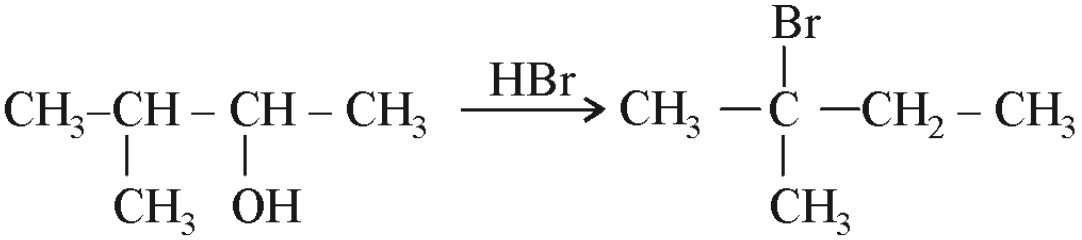
When 3-methylbutan-2-ol is treated with HBr , the following reaction takes place :
Image
Give a mechanism for this reaction.
(Hint : The seconary carbocation formed in step II rearranges to a more stable tertiary carbocation by a hydride ion shift from 3rd carbon atom.)
(a) Give Reasons -
(i) Monochloro ethanoic acid has a higher P ka value than dichloro ethanoic acid.
(ii) Ketones are less reactive towards nucleophilic addition reaction than aldehydes.
(b) Write short note on aldol condensation
(a) Out of the following pairs, predict with reason which pair will allow greater conduction electricity:
(i) Silver wire at $30^{\circ}C$ or silver wire at $60^{\circ}C.$
(ii) 0.1 M $CH_{3}COOH$ solution or 1 M $CH_{3}COOH$ solution.
(iii) KCl solution at $20^{\circ}C$ or KCl solution at $50^{\circ}C$.
(b) Give two points of differences between electrochemical and electrolytic cells.
Vapour pressure of water at 293 K is 17.535 mm Hg. Calculate the vapour pressure of water at 293 K when 25 g of glucose is dissolved in 450 g of water.
Read the following text carefully and answer the questions that follow:
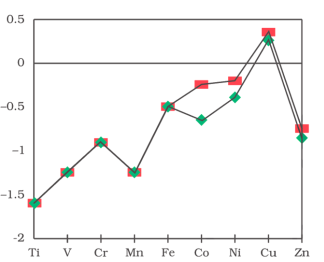
The transition metals when exposed to oxygen at low and intermediate temperatures form thin, protective oxide films of up to some thousands of Angstroms in thickness. Transition metal oxides lie between the extremes of ionic and covalent binary compounds formed by elements from the left or right side of the periodic table. They range from metallic to semiconducting and deviate by both large and small degrees from stoichiometry. Since delectron bonding levels are involved, the cations-exist in various valence states and hence give rise to a large number of oxides. The crystal structures are often classified by considering a cubic or hexagonal close-packed lattice of one set of ions with the other set of ions filling the octahedral or tetrahedral interstices. The actual oxide structures, however, generally show departures from such regular arrays due in part to distortions caused by packing of ions of different size and to ligand field effects. These distortions depend not only on the number of d-electrons but also on the valence and the position of the transition metal in a period or group.
i. Why does copper, which is in first series of transition metal exhibits +1 oxidation state most frequently? (1)
ii. The lowest oxide of transition metal is basic. Why? (1)
iii. The variability in oxidation states of d-block different from that of the p-block elements. Explain. (2)