Question
What are permanent magnets? Give one example.

Answer

Substances, which at room temperature, retain their ferromagnetic property for a long period of time are called permanent magnets. Alnico, cobalt, steel and ticonal.

Need a full question paper?

Generate a complete, print-ready paper with questions like this in minutes — across 16+ boards, with answer keys.
Start Generating Free

Similar questions

What will be the shape of the wave front of light emerging from a point source?
For the same value of angle of incidence, the angles of refraction in three media A, B and C are 15°, 25° and 35° respectively. In which medium would the velocity of light be minimum?
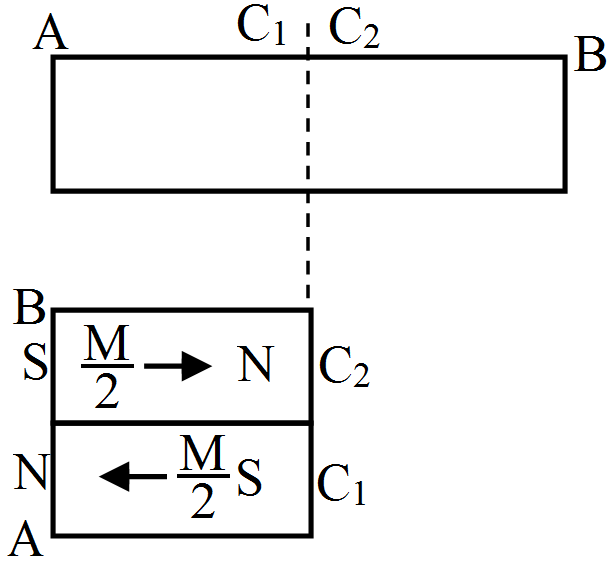
A hypothetical bar magnet $(AB)$ is cut into two equal parts. One part is now kept over the other, so that the pole $C_2$ is above $C_1.$ If $M$ is the magnetic moment of the original magnet, what would be the magnetic moment of the combination, so formed?
What is the magnitude of the torque and also give its direction.
When a glass lens with refractive index 1.45 is immersed in a liquid, it is not visible. What will be the refractive index of the liquid?
The polarising angle of a medium is 60°. What is the refractive index of the medium?
Answer the following:
What are the forms of energy into which the electrical energy of the atmosphere is dissipated during a lightning? $($Hint: The earth has an electric field of about $100Vm^{–1}$ at its surface in the downward direction, corresponding to a surface charge density $= –10^{–9}Cm^{–2}$​​​​​​​. Due to the slight conductivity of the atmosphere up to about $50\ km \ ($beyond which it is good conductor$),$ about $+ 1800C$ is pumped every second into the earth as a whole. The earth, however, does not get discharged since thunderstorms and lightning occurring continually all over the globe pump an equal amount of negative charge on the earth.$)$
A proton and an electron have equal speeds. Find the ratio of de Broglie wavelengths associated with them.
Write any two conditions for total internal reflection.
Sketch a graph showing variation of resistivity of carbon with temperature.