Question
What are permanent magnets? What is an efficient way of preparing a permanent magnet? Write two characteristic properties of materials which are required to select them for making permanent magnets.

Answer

Permanent Magnets: The magnets prepared from ferromagnetic materials which retain their magnetic properties for a long time are called permanent magnets. An efficient way to make a permanent magnet is to place a ferromagnetic rod in a solenoid and pass a current. The magnetic field of the solenoid magnetises the rod.
The materials used for permanent magnet must have the following characteristic properties:
  1. High retentivity so that the magnet may cause strong magnetic field.
  2. High coercivity so that the magnetisation is not wiped out by strong external fields, mechanical ill-treatment and temperature changes. The loss due to hysteresis is immaterial because the magnet in this case is never put to cyclic changes.

Need a full question paper?

Generate a complete, print-ready paper with questions like this in minutes — across 16+ boards, with answer keys.
Start Generating Free

Similar questions

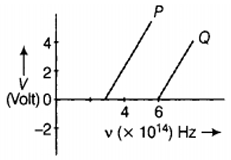
In the study of a photoelectric effect, the graph between the stopping potential $V$ and frequency of the incident radiation on two different metals $P$ and $Q$ is shown below.
Image
$i$. Which one of the two metals has higher threshold frequency?
$ii.$ Determine the work function of the metal which has greater value.
Average lifetime of a hydrogen atom excited to $n = 2$ state is $10^{-8}s$. Find the number of revolutions made by the electron on the average before it jumps to the ground state.
$a$ . Differentiate between nuclear fission and nuclear fusion.
$b$ . Deuterium undergoes fusion as per the reaction:
${ }_1^2 H +{ }_1^2 H \longrightarrow{ }_2^3 He +{ }_0^1 n +3.27 MeV$
Find the duration for which an electric bulb of $500 W$ can be kept glowing by the fusion of $100 g$ of deuterium.
Suppose white light falls on a double slit but one slit is covered by a violet filter (allowing $\lambda=400\text{nm}$). Describe the nature of the fringe pattern observed.
A long, straight wire carries a current. Is Ampere's law valid for a loop that does not enclose the wire? That encloses the wire but is not circular?
$i.$ Define the term self-inductance and write its $S.I$. unit.
$ii$. Obtain the expression for the mutual inductance of two long co $-$ axial solenoids $S_1$ and $S_2$ wound one over the other, each of length $L$ and radii $r_1$ and $r_2$ and $n_1$ and $n_2$ number of turns per unit length, when a current $I$ is set up in the outer solenoid $S _2$.
A convex lens made up of glass of refractive index 1.5 is dipped, in turn, in:
  1. Medium A of refractive index 1.65
  2. Medium B of refractive index 1.33
Explain, giving reasons, whether it will behave as a converging lens or a diverging lens in each of these two media.
When $1.0 \times 10^{12}$ electrons are transferred from one conductor to another, a potential difference of $10V$ appears between the conductors. Calculate the capacitance of the two $-$ conductor system.
Two particles, carrying charges -q and +q and having equal masses m each, are fixed at the ends of a light rod of length a to form a dipole. The rod is clamped at an end and is placed in a uniform electric field E with the axis of the dipole along the electric field. The rod is slightly tilted and then released. Neglecting gravity find the time period of small oscillations.
Estimate the number of electrons in $100g$ of water. How much is the total negative charge on these electrons?